

SIP Trunk for Enterprise PBX, PRI Migration and Voice Modernization
SIP Trunk is an enterprise voice connectivity service that connects a PBX, IP PBX, unified communications platform or contact centre system to public calling through Session Initiation Protocol. It uses IP networks for call signalling and usually RTP for media, so call quality depends on the complete design: access link, firewall, public IP, codec, routing, security policy, provider path and operational support.
For CIOs, CTOs, IT managers, voice engineers, network architects and procurement teams, SIP Trunking is a voice architecture decision, not only a channel purchase. It is useful when an organisation wants to modernize legacy voice, retain PBX control, support DID numbers, plan contact centre capacity, migrate away from PRI in phases and prepare for Cloud Telephony where it fits the business model.
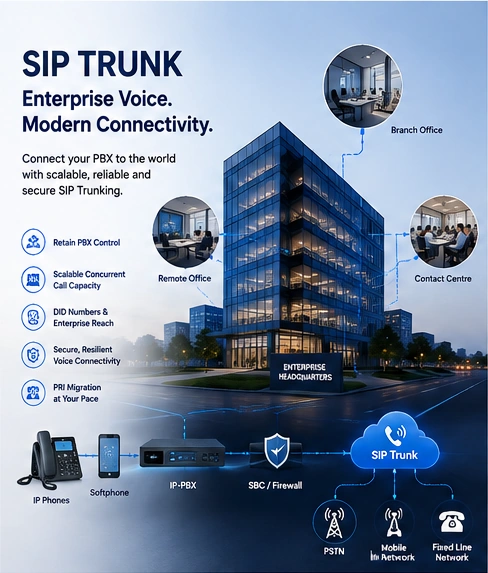
Enterprise SIP Trunk Overview
SIP Trunking moves the trunk connection between an enterprise voice system and a provider onto an IP-based design. The enterprise may keep its PBX, IP PBX or contact centre platform while using SIP to route inbound and outbound calls through the provider network. This makes SIP relevant for organisations that need continuity from existing telephony while preparing for cloud-first communication models.
The business outcome depends on readiness. A good SIP project reviews current PRI or phone services, DID inventory, peak call concurrency, firewall behaviour, internet access, static public IP, SBC requirement, voice VLANs, QoS policy, support process and failover design before number movement or cutover.
Business Outcomes
PBX continuity: Keep existing PBX control while modernizing the trunk layer.
PRI migration: Move from fixed legacy circuits through a phased, testable coexistence plan.
DID control: Document number ownership, routing, caller ID and failover before cutover.
Contact centre resilience: Size channels, RTP paths and failover around actual call concurrency.
Key SIP Trunk Capabilities
SIP Trunk capabilities should be evaluated by how they support call control, call quality, migration risk and operational visibility. A channel count alone does not describe whether the service will work well for a branch, head office or contact centre.
01
Concurrent Call Channels
Size channels from measured simultaneous calls, campaign peaks, IVR traffic, outbound calling, conferencing and growth instead of user count alone.
02
DID Number Routing
Map main numbers, department numbers, user DIDs, queues, IVRs, caller ID and backup routing before migration.
03
PBX and IP PBX Integration
Confirm SIP compatibility, codec support, dial plan, inbound routes, outbound routes, licensing and vendor support before cutover.
04
Firewall and SBC Readiness
Review NAT, provider allowlisting, SIP ports, RTP ranges, SIP inspection, session timers, logging and fraud-control boundaries.
05
Voice Quality Control
Plan codec, latency, jitter, packet loss, QoS, access-link utilization and monitoring for the real traffic path.
06
Failover and DR Routing
Define what happens to inbound and outbound calls during link, firewall, PBX, provider or site failure.
Architecture and Design
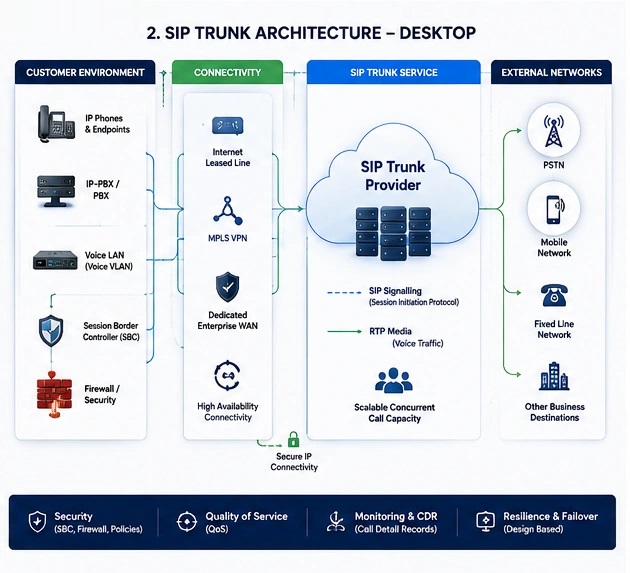
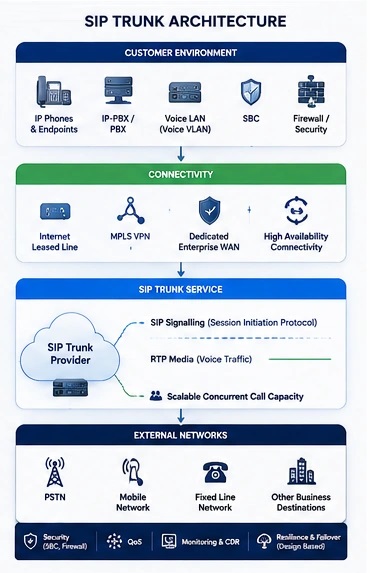
A production SIP Trunk architecture normally includes IP phones or softphones, LAN switching, voice VLANs, PBX or IP PBX, a Session Border Controller where required, firewall, router, static public IP, access link and SIP provider platform. The architecture must show both signalling and media because a call can connect successfully while audio fails due to RTP or NAT issues.
Design checkpoints: SIP authentication model, provider IP allowlisting, public IP mapping, SIP port and RTP range policy, voice codec, QoS, caller ID policy, DID routing, emergency assumptions, fraud controls, logging, monitoring and failover behaviour.
Related technologies: Internet Leased Line, Cloud Telephony, PRI, Enterprise Networking, Enterprise Security, Managed IT Services and contact centre systems.
Enterprise Use Cases and Industries
SIP Trunk is relevant where voice remains business-critical and the organisation needs controlled integration with a PBX, contact centre, branch network or migration programme. It can support headquarters voice, multi-branch calling, contact centres, healthcare appointment lines, retail store support, logistics dispatch, banking operations, hospitality reservations, IT service desks and education administration.
Contact Centres and BPO
Plan channel concurrency, campaign peaks, recording path, DID routing, IVR, queues, dialer behaviour, failover routing and agent quality monitoring.
Multi-Branch Enterprises
Decide whether calls break out centrally, locally or through cloud voice depending on branch criticality, WAN design and operational ownership.
PRI Modernization
Use coexistence, pilot numbers, rollback planning and post-cutover testing before retiring legacy circuits.
Deployment and Feasibility
A SIP Trunk deployment should start with a readiness assessment before number movement. The early enquiry should capture City / Area / Location Name + Pincode, PBX type, current voice services, DID inventory, expected concurrent calls, contact centre requirement, internet link type, firewall model, static public IP availability and migration timeline. Full installation addresses are collected later during feasibility, technical validation, provider coordination or order processing.
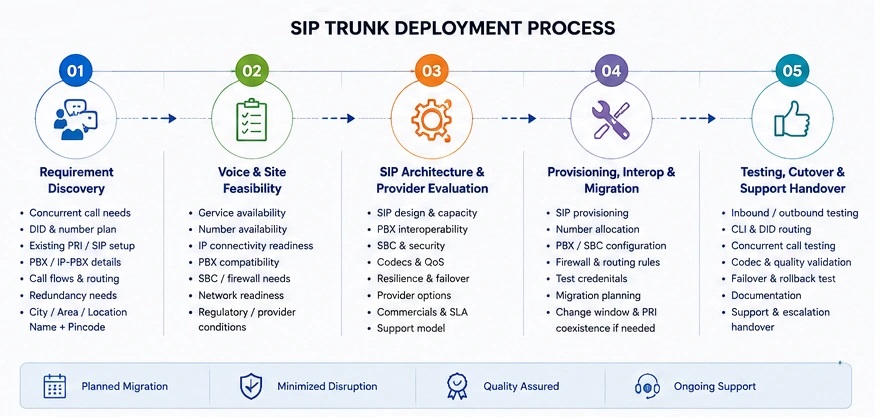
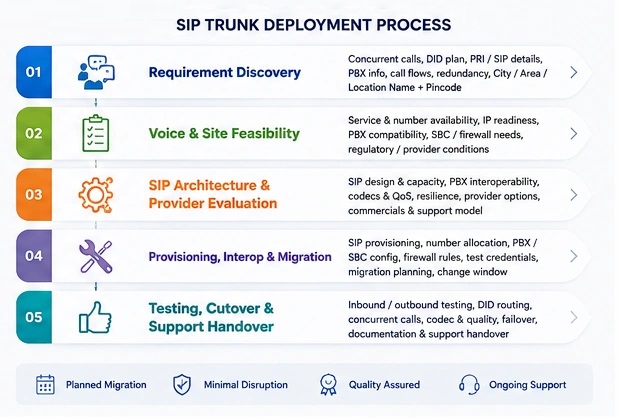
Discovery
Document PBX, IP PBX, current PRI or phone services, DID numbers, call flows, IVR, queues, recording, fax, alarm lines, internet links, firewall and operational ownership.
Readiness
Confirm static public IP, NAT policy, SIP and RTP rules, SBC requirement, codec, QoS, link stability, provider allowlisting and monitoring readiness.
Pilot
Test inbound calls, outbound calls, caller ID, DID mapping, IVR, queues, RTP media, one-way audio scenarios, failover and call quality under load.
Cutover
Move numbers and production traffic through a planned window with rollback, user communication and post-cutover validation.
Operations
Track provider status, call failures, RTP quality, firewall logs, fraud alerts, capacity trends and support escalation records.
Why CloudShots Technologies
CloudShots Technologies supports SIP Trunk planning as a provider-neutral coordination and evaluation layer. The engagement should make requirements, feasibility, commercial dependencies and implementation ownership clear without assuming one carrier in advance or making unsupported service guarantees.
01
Provider-Neutral Evaluation
Evaluate enterprise SIP Trunk requirements and feasible provider/service options without assuming one telecom carrier in advance.
02
Requirement-Led Planning
Base planning on PBX/IP-PBX environment, concurrent calls, DID requirements, sites, connectivity readiness, QoS, security, resilience and migration requirements.
03
Technical-Commercial Comparison
Compare feasibility, PBX compatibility, SIP architecture, concurrent-call capacity, numbering requirements, commercials, implementation dependencies and support model.
04
Single Point of Engagement
Position CloudShots as the coordination point among customer business teams, IT/network/voice teams, provider/channel teams and implementation stakeholders, keeping assumptions, dependencies and next actions visible.
SIP Trunk FAQs
Common questions about SIP Trunk architecture, PBX compatibility, concurrent call capacity, migration, voice quality and service feasibility.
Ready to Build a More Reliable Enterprise Network?
Share your locations, bandwidth requirements and expected activation timeline. CloudShots Technologies will help evaluate feasibility, coordinate suitable providers and identify the right connectivity approach for your business.