IT & ITES2026-11-18T23:47:52+05:30

IT & ITES ENTERPRISE INFRASTRUCTURE

Enterprise Connectivity & Technology Infrastructure for IT & ITES

Plan connectivity, cloud access and secure networks around the applications your delivery teams depend on.

CloudShots Technologies helps development centres, technology campuses and distributed service operations evaluate suitable infrastructure, compare provider options and coordinate implementation. Resilience starts with understanding dependencies and testing recovery, not simply ordering another circuit.

Technology Infrastructure for Software and Service Delivery

IT and IT-enabled service operations move source code, business data, voice and collaboration traffic between offices, remote users, cloud platforms and customer environments. Their requirements differ by workload, time zone and the consequences of losing access. A useful assessment identifies application paths, ownership and recovery priorities before selecting services.

Modern technology campus with development and delivery offices

Development centres

Plan repository access, build-artifact transfers and test environments around concurrent development activity, not only employee headcount.

Service delivery centres

Identify voice, collaboration and customer-system dependencies across shifts. Agree capacity and recovery priorities with operational owners.

Technology campuses

Coordinate building uplinks, wireless access, switching and WAN paths so a local bottleneck is not mistaken for a carrier fault.

Distributed engineering teams

Define consistent access policies across offices while accounting for site-specific services, equipment and local support arrangements.

Shared services operations

Separate corporate administration, customer delivery and visitor access where business requirements call for distinct trust boundaries.

Hybrid working

Evaluate identity, endpoint posture and remote access together. Home broadband and remote endpoints remain separate dependencies.

Core Technology Requirements for IT & ITES

Choose capabilities against the delivery model, application dependencies and agreed operating responsibilities.

Enterprise switching and access infrastructure for a development centre

Application-aware connectivity

Measure busy-hour demand, latency, loss and jitter for the applications that matter. Separate large data transfers from interactive workloads when evaluating capacity.

Resilience and recovery

Consider diverse access paths, power, firewall availability and routing behavior. Test representative sessions during failover; dual links alone do not prove continuity.

Cloud access

Map regions, routing, DNS, identity and any available private interconnection. Confirm bandwidth and recovery requirements for both office and remote access.

Security boundaries

Separate delivery projects, administration, guest access and management traffic where required. Define permitted flows and who approves exceptions.

Campus and wireless capacity

Assess uplinks, switching, access-point placement and peak user density together. WAN capacity cannot compensate for overloaded local wireless cells.

Operational visibility

Agree monitoring ownership, alert routing, configuration backups and escalation information across customer, carrier and support teams.

An Illustrative IT & ITES Connectivity Architecture

This reference path supports design discussions; it is not a guaranteed deployment topology. Actual routing, security placement and recovery options depend on site feasibility, application ownership and the selected services.
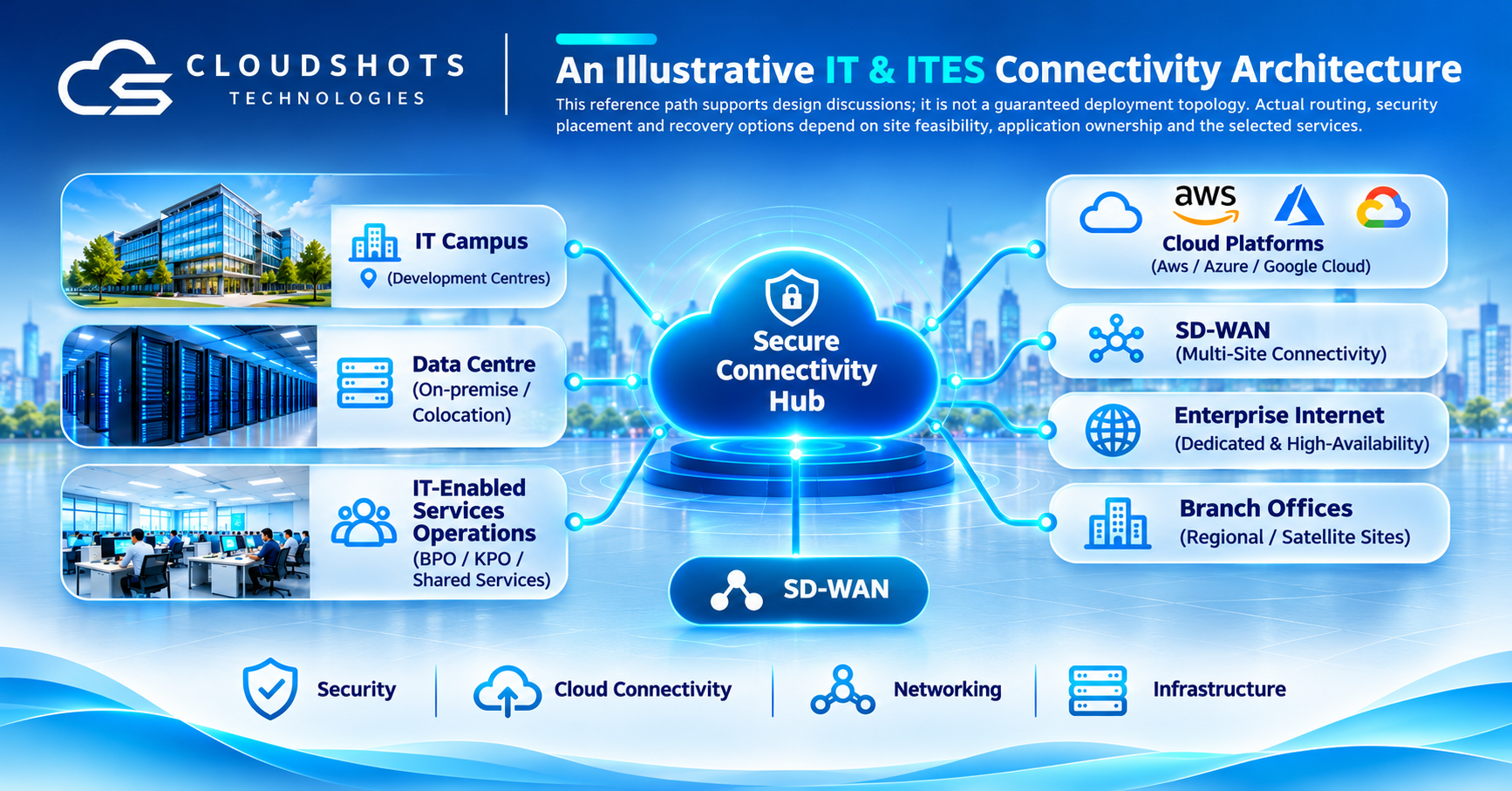
Illustrative IT and ITES connectivity architecture showing IT campuses, data centres, branch offices and cloud platforms connected through secure enterprise networking, SD-WAN and enterprise internet.
Staff devices and engineering workstations → access switching / wireless → segmented campus network → security gateway → enterprise WAN or internet → approved cloud, data-centre and customer applications.

Remote users reach approved resources through the agreed identity and access controls. A management plane handles monitoring and configuration separately from application traffic where the design requires it.

A secondary WAN path can offer an alternate route, subject to physical diversity, surviving capacity and policy behavior. Check shared ducts, local power, gateway dependencies and provider handoffs. Private routing such as MPLS VPN does not automatically encrypt application traffic.

Cloud connectivity may use internet paths or available private interconnection. Confirm addressing, route advertisement, DNS resolution, authentication and recovery for each application path before acceptance.

Operational Challenges and Design Considerations

Resolve constraints early so procurement and implementation follow an agreed technical brief.

Network architect reviewing development-centre capacity and site plans

Busy-hour performance

Build pipelines, backups and software distribution can compete with interactive sessions. Measure concurrency and schedule bulk transfers where the application permits.

Failover behavior

Test routing convergence, security state and application reconnection. Record recovery time observed in tests rather than promising uninterrupted sessions.

Customer environment separation

Clarify boundaries between customer projects, corporate services and management access. Review exceptions and shared-service dependencies.

Site and path diversity

Validate building entry, last-mile route and upstream dependencies. Two products with different names may still share physical infrastructure.

Legacy integration

Check addressing, supported software, licensing and equipment capacity before migration. Define a rollback plan for services that cannot move together.

Growth and commercial scope

Plan incremental users, sites and workloads alongside contract terms, delivery lead times, support scope and renewal responsibilities.

Practical IT & ITES Use Cases

These scenarios illustrate assessment choices, not completed customer deployments.

Distributed engineering offices and collaboration spaces

Opening a development centre

Scenario: a new office needs access to repositories and cloud tools. Requirement: predictable capacity and controlled user access. Approach: assess dedicated internet, campus networking and security gateways. Consideration: building feasibility and equipment readiness can set the delivery schedule.

Connecting delivery locations

Scenario: teams in multiple cities share customer applications. Requirement: consistent routing and visibility. Approach: compare suitable WAN options and SD-WAN policies. Consideration: overlay design still depends on the available underlay links.

Supporting hybrid engineering

Scenario: engineers alternate between office and remote work. Requirement: approved access from managed endpoints. Approach: coordinate identity, endpoint controls and secure remote access. Consideration: customer policies and home-network conditions may limit the experience.

Moving workloads to cloud

Scenario: development or collaboration workloads move between platforms. Requirement: dependable application paths. Approach: evaluate internet and available private cloud access with route and DNS testing. Consideration: region, egress costs and identity dependencies affect the choice.

Upgrading a technology campus

Scenario: user density and traffic grow across buildings. Requirement: scalable access and uplinks. Approach: assess switching, fibre and wireless capacity. Consideration: installation access, power and phased cutover windows constrain deployment.

Testing business recovery

Scenario: a primary link or gateway becomes unavailable. Requirement: essential workflows continue within agreed recovery objectives. Approach: test alternate paths with representative applications. Consideration: spare bandwidth and session behavior must be validated, not assumed.

Technology Solutions Matched to Your Requirements

No single service fits every IT operating model. Compare the following options against the same documented requirements. Backup connectivity is a design requirement, not an assumed standalone product.

Internet Leased Line

Assess dedicated access for business applications against busy-hour capacity, site availability and contracted terms.

SD-WAN

Evaluate application-aware routing across suitable links, with clear security and operational ownership.

Cloud Connectivity

Review office-to-cloud paths, routing, region access and backup connectivity.

Point-to-Point Connectivity

Assess specified site-to-site links for shared applications or data transfer requirements.

MPLS VPN

Compare private multi-site routing where appropriate; evaluate encryption requirements separately.

Enterprise Networking

Coordinate campus switching, segmentation and management around the actual access model.

Managed Wi-Fi

Plan radio coverage, user density, authentication and the scope of ongoing operations.

Firewall

Evaluate policy enforcement, inspection capacity and secure access at defined boundaries.

Feasibility, Implementation and Handover

CloudShots coordinates assessment and delivery activities with the customer and relevant providers. Availability, timelines and ongoing responsibilities are confirmed for the specific requirement.

Engineers validating enterprise network connections before handover

Requirement discovery

Record sites, teams, shifts, critical applications and current constraints. Agree acceptance criteria with IT and delivery owners.

Location and site assessment

Review building access, cabling, power, existing equipment and installation windows. Capture known gaps before ordering.

Carrier feasibility

Coordinate service-availability and proposed-path checks. Distinguish confirmed availability from estimates and identify outstanding dependencies.

Technology selection

Assess interfaces, licensing, capacity, security integration and the operational support model.

Technical and commercial evaluation

Compare scope, exclusions, recurring costs and support responsibilities alongside technical suitability.

Implementation coordination

Agree change ownership, cutover sequence, configuration backups and rollback steps across customer and delivery teams.

Testing and handover

Validate agreed application paths and recovery cases. Record exceptions, configuration information and escalation contacts.

Application Paths to Include in the Assessment

These workload categories complement the deployment scenarios above. They identify what to measure and protect within the design.

Explore other operating environments in the Industries Hub.

Source control and CI/CD

Characterise repository, artifact and automation traffic; distinguish routine interactions from large build transfers.

Voice and collaboration

Review packet loss, delay and jitter across the complete path, including local access and application providers.

Virtual desktops and remote access

Evaluate session performance, authentication and gateway capacity alongside endpoint and access-link conditions.

Monitoring and administration

Separate management access, define logs needed for incident investigation and assign configuration ownership.

Why CloudShots Technologies?

CloudShots Technologies is a provider-neutral technology coordination and implementation partner. Recommendations and support depend on the agreed requirements and service scope.

Technical specialists reviewing a multi-location IT infrastructure plan

Requirements-led assessment

Start with business workflows and technical dependencies rather than a preferred product list.

Provider-neutral evaluation

Compare suitable services against a common brief, including assumptions, exclusions and responsibilities.

Feasibility coordination

Track site checks and dependencies so an indicative option is not mistaken for a confirmed delivery commitment.

Implementation coordination

Align customer teams, carriers and implementation partners around the agreed change and acceptance plan.

Multi-location project support

Maintain shared design principles while recording local feasibility and equipment differences.

Ongoing service coordination

Where included in the agreed scope, align escalation contacts and follow-up activities without implying ownership of carrier networks.

IT & ITES Technology FAQs

Practical answers about connectivity, architecture and delivery responsibilities.

What connectivity should an IT development centre assess?2026-11-18T15:11:18+05:30

Start with application traffic, concurrent users, cloud access and recovery needs. Dedicated internet, site-to-site services or other available options can then be compared against location feasibility and the operating model.

Does SD-WAN replace the underlying internet or WAN links?2026-11-18T15:11:47+05:30

No. SD-WAN policies operate across underlying connections. Link availability, capacity, loss and path diversity still affect the result; management and security responsibilities also need to be defined.

Do two internet links guarantee uninterrupted operations?2026-11-18T15:12:23+05:30

No. They may share physical paths, power or other dependencies. Routing, gateway behavior and application sessions must be tested under failure conditions against agreed recovery objectives.

When should private cloud connectivity be considered?2026-11-18T15:12:51+05:30

Consider it when workload, routing, bandwidth and available interconnection options justify it. Compare internet access and private connectivity against security requirements, regions, costs and recovery paths.

Can existing switches and firewalls be retained?2026-11-18T15:13:28+05:30

Potentially, if supported capacity, software lifecycle, interfaces, licensing and security integration fit the design. Review existing configuration and migration constraints before deciding what to retain.

How should customer-project networks be separated?2026-11-18T15:14:04+05:30

Define trust boundaries and permitted flows with the relevant owners. Segmentation may involve VLANs, routing and security policies; a VLAN alone does not establish all required security controls.

What should be tested before accepting a new connection?2026-11-18T15:14:31+05:30

Check agreed throughput conditions, application reachability, routing, DNS and authentication. Include relevant failover scenarios, record observed behavior and document exceptions and ownership.

How are remote engineers included in the design?2026-11-18T15:15:05+05:30

Assess identity, managed endpoints, remote-access controls and application requirements together. Home access links and customer security policies remain separate dependencies.

Does CloudShots operate the carrier network?2026-11-18T15:15:42+05:30

CloudShots supports provider-neutral assessment, solution evaluation and implementation coordination. Carrier services and their contractual commitments remain subject to the relevant provider arrangements.

What information is needed for an initial discussion?2026-11-18T15:16:18+05:30

Share site locations, user counts, shifts, key applications, current services and the operational issue. Include growth plans and desired timescales, but do not send passwords or sensitive customer data through the enquiry form.

Discuss Your IT & ITES Infrastructure Requirements

Share your delivery locations, critical applications, current services and growth plans. CloudShots Technologies can help assess suitable options and coordinate the next feasibility steps.

City or area and postcode are sufficient for the initial location discussion. Detailed technical information can follow through the agreed assessment process.

Modern technology office and campus environment
Go to Top