

SD-WAN for Reliable Branch Connectivity and Cloud-First WAN Control
SD-WAN is a software-defined wide area network architecture that uses centralized policy, application awareness and path monitoring to control how enterprise traffic moves between branches, headquarters, cloud platforms, data centres and security services. It helps distributed organizations use multiple connectivity paths without treating every link as equal or every application as the same priority.
For CIOs, CTOs, network architects and procurement teams, the value of SD-WAN is not the appliance alone. The value comes from a well-designed underlay, clean routing, security integration, documented policy ownership and measurable operations. CloudShots Technologies helps enterprises evaluate SD-WAN as part of a complete WAN decision that can include Internet Leased Line, MPLS VPN, cloud connectivity, enterprise security and managed IT services.
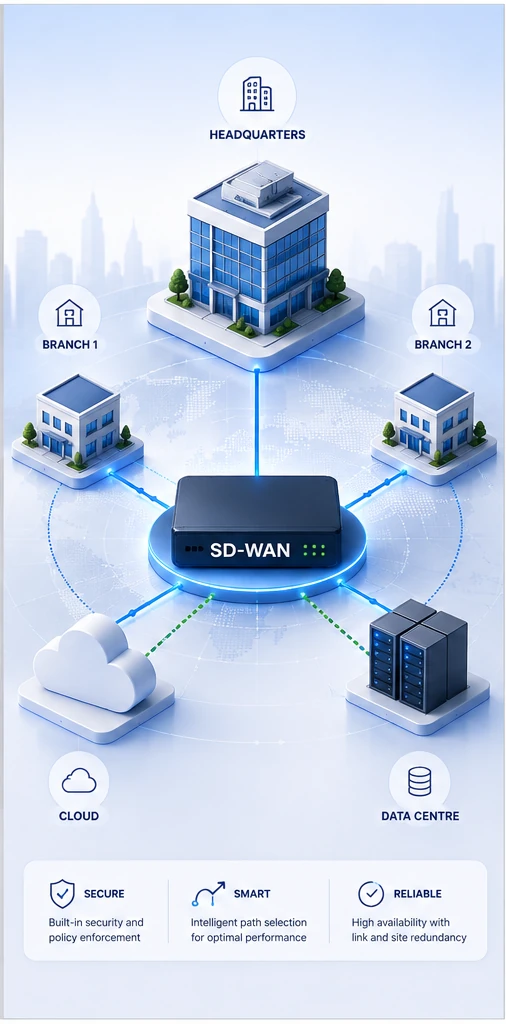
SD-WAN Overview
SD-WAN separates WAN control from individual circuits. Branch edges build a secure overlay across available underlay links, then apply business policy to decide where application traffic should go. A well-planned design can steer latency-sensitive traffic to the best available path, keep cloud applications closer to users, and provide better visibility than a static branch network.
The enterprise discussion should start with business outcomes: which sites are critical, which applications need predictable experience, which workloads are moving to cloud, and which teams will own day-two policy changes. SD-WAN works best when these questions are answered before hardware, licensing or managed service scope is finalized.
Business Outcomes
Branch consistency: Standardize WAN policy across offices, warehouses, stores, clinics, contact centres and remote operating sites.
Cloud access control: Route SaaS and IaaS traffic with clearer visibility, security inspection and performance intent.
Application experience: Use measured path quality to improve handling for voice, video, ERP, payment and collaboration traffic.
Operational visibility: Give IT teams a better view of site health, link behavior, failover events and application usage.
Key SD-WAN Capabilities
SD-WAN capabilities should be evaluated by how they solve real WAN operating problems. A feature is useful only when it is mapped to site criticality, application behavior, routing policy, security rules and support ownership.
01
Application-Aware Routing
SD-WAN can classify traffic by application type and route it according to business policy. This is useful when voice, video, ERP, cloud collaboration and background traffic should not receive identical treatment.
02
Dynamic Path Selection
Path decisions can consider latency, jitter, packet loss and availability instead of relying only on static routing. This helps branches use the most suitable active path for each class of traffic.
03
Centralized Policy Management
Network teams can define repeatable templates for branches, cloud access, security zones and failover behavior. This reduces configuration drift as the site count grows.
04
Secure Overlay Tunnels
The overlay can secure site-to-site traffic across multiple underlays. Encryption and segmentation must still be aligned with firewall, identity and compliance requirements.
05
Segmentation and Access Control
Traffic can be separated by department, branch role, application class or security zone. The design should be simple enough to operate and strict enough to limit avoidable exposure.
06
Visibility and Analytics
Dashboards and reports can show site health, path quality, traffic classes and failover events. This improves operations only when alerts, ownership and escalation are defined.
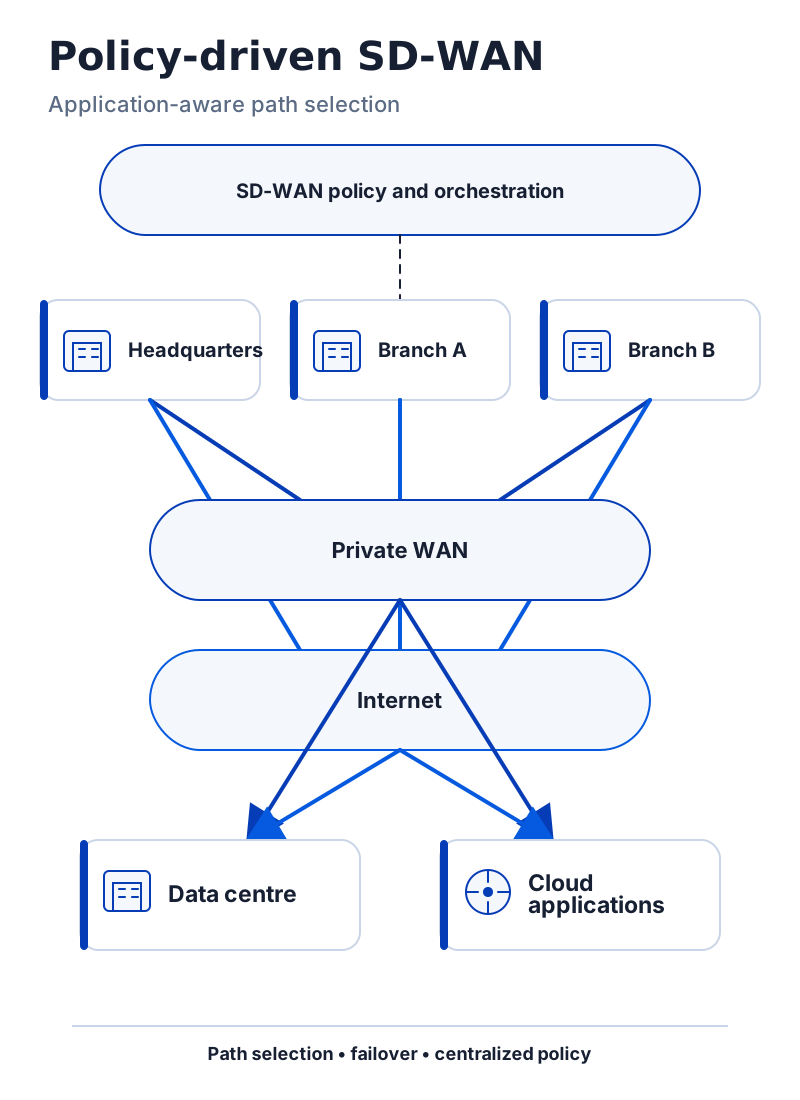
Architecture and Design
An SD-WAN architecture has two layers: the underlay that carries packets and the overlay that applies policy. The underlay may include Internet Leased Line, MPLS VPN, 5G backup, P2P Leased Line, data centre connectivity or cloud access. The overlay connects SD-WAN edges and applies routing, segmentation, security and failover policy.
Design considerations:
1. Classify sites by business criticality, uptime impact and application dependency.
2. Validate link diversity, provider reach, last-mile ownership and backup path behavior.
3. Define routing, IP addressing, NAT, DNS and firewall handoff before deployment.
4. Align SD-WAN policy with enterprise security, SASE, Zero Trust and monitoring requirements.
5. Document day-two ownership for policy changes, incident response and reporting.
Use Cases
Multi-branch WAN: Standardize policy across branches while allowing each site to use the most feasible connectivity design.
Cloud-first application access: Improve visibility and path control for SaaS, IaaS and cloud-hosted business applications.
Hybrid WAN: Use SD-WAN alongside MPLS VPN, Internet Leased Line and private cloud connectivity where different traffic classes need different treatment.
Voice and collaboration: Route real-time traffic according to measured link quality and documented failover rules.
Business continuity: Build backup paths, test failover and keep branch operations available during circuit incidents where alternate connectivity is feasible.
Industries Served
Retail: Store connectivity, payment systems, inventory systems and secure cloud access.
Healthcare: Clinic and hospital site connectivity where application availability, privacy controls and support escalation matter.
Manufacturing: Plant, warehouse and office connectivity with segmentation for operational and corporate networks.
Banking and financial services: Controlled branch access, security policy alignment and reliable application paths.
Education, logistics and BPO: Distributed operations that need repeatable branch templates, visibility and scalable support.
Deployment and Feasibility
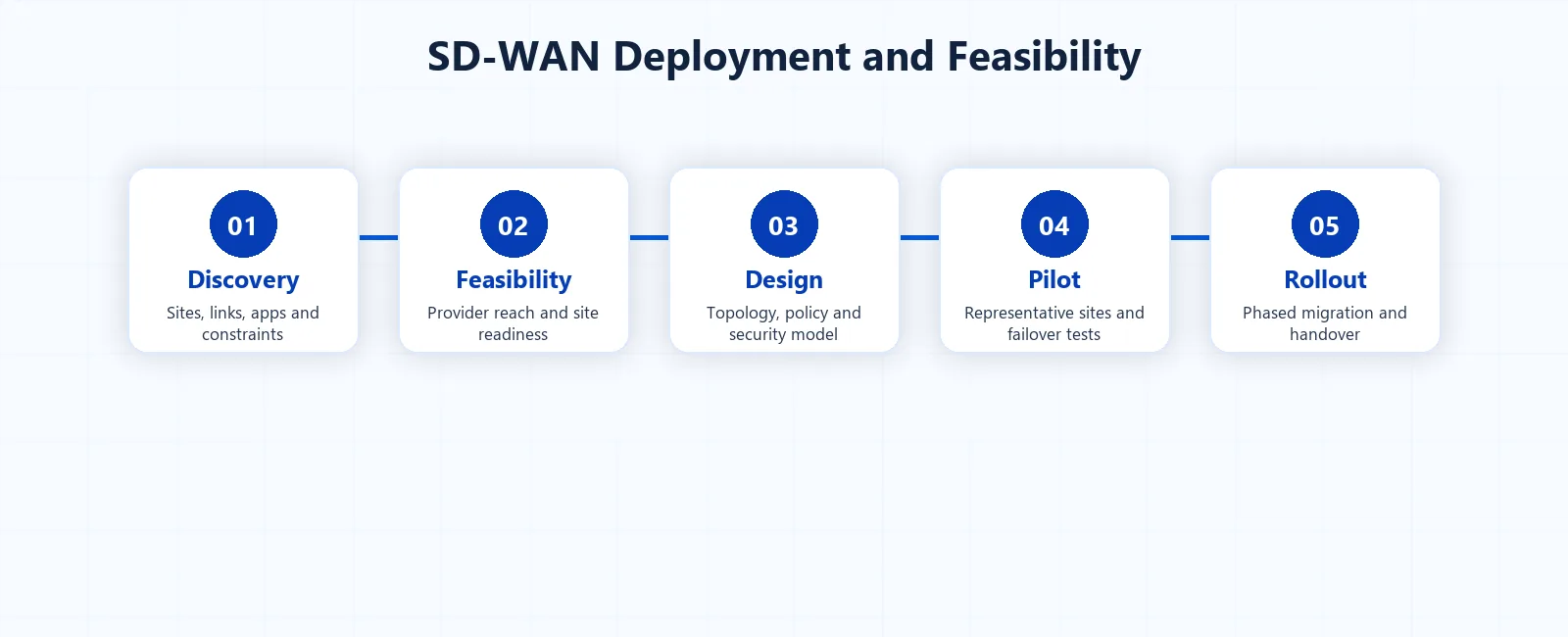
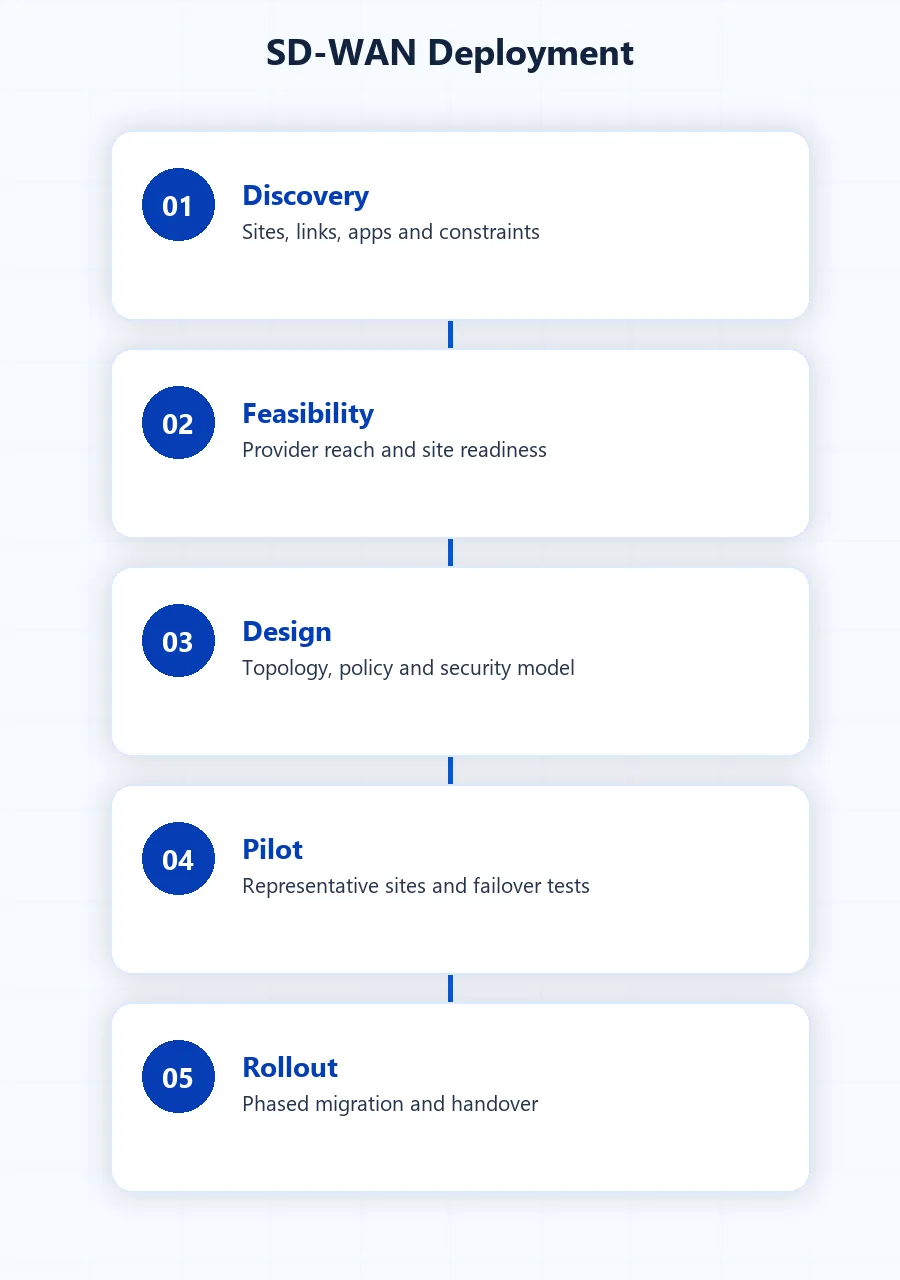
SD-WAN deployment should begin with feasibility, not only product selection. At the website enquiry stage, capture site count, City / Area / Location Name, Postal Pincode, current WAN/connectivity, applications, user profile, bandwidth, cloud/SaaS dependencies, security requirements, resilience requirements and business timelines. Full installation addresses are collected later during feasibility, technical validation, provider coordination or order processing.
Discovery and Site Inventory
Capture site count, City / Area / Location Name, Postal Pincode, current WAN/connectivity, applications, user profile, bandwidth, cloud/SaaS dependencies, security requirements, resilience requirements, business timelines, provider names, routing, IP addressing, firewall rules and business pain points. Full installation addresses are collected later during feasibility, technical validation, provider coordination or order processing.
Feasibility and Underlay Review
Check link availability, service feasibility, carrier diversity, last-mile options, building readiness and backup choices for each location. Critical sites should be reviewed separately from low-impact branches.
Architecture and Policy Design
Define topology, edge sizing, routing, segmentation, security inspection, cloud access, application classes, failover behaviour, monitoring requirements and managed service responsibilities.
Pilot and Acceptance Testing
Deploy representative sites first. Test application steering, failover, latency-sensitive traffic, cloud access, firewall logging, management visibility and support escalation before wider rollout.
Phased Rollout and Handover
Migrate sites in waves, document the policy model, confirm escalation paths and hand over reporting ownership. Each rollout wave should close with acceptance results and a known issues log.
Why CloudShots for SD-WAN Planning
CloudShots Technologies approaches SD-WAN as an enterprise architecture decision. The engagement is provider-neutral and requirement-led: site feasibility, underlay quality, routing, security, cloud access and support ownership are reviewed before a commercial recommendation is treated as final.
01
Provider-Neutral Evaluation
CloudShots evaluates requirements and feasible provider or connectivity options without assuming one carrier, access path or SD-WAN platform in advance. This keeps the review aligned to business need and local feasibility.
02
Requirement-Led Planning
Planning starts with sites, applications, bandwidth, QoS, resilience, security, cloud dependencies and business priorities. The SD-WAN design is then matched to what the organization actually needs to operate.
03
Technical-Commercial Comparison
Options are compared across feasibility, architecture fit, resilience, licensing and commercials, implementation dependency and support model so IT and procurement can review the same decision frame.
04
Single Point of Engagement
CloudShots coordinates customer business teams, IT and network teams, provider or channel teams, and implementation stakeholders while keeping assumptions, dependencies and next actions visible.
SD-WAN FAQ
These answers address practical SD-WAN questions that usually arise during architecture review, procurement comparison and rollout planning. They are maintained as SD-WAN FAQ entries and displayed through the Avada FAQ accordion.
Plan SD-WAN With the Right Underlay, Security and Operations Model
Share your site count, application priorities, current WAN links, cloud platforms and security expectations. CloudShots Technologies can help review the SD-WAN architecture, feasibility and rollout approach before you move into commercial comparison.