

ENTERPRISE CLOUD ACCESS
Cloud Connectivity for Enterprise Networks
Connect your head office, branches, campus or data centre to cloud environments through private or dedicated connectivity. CloudShots Technologies helps define the access, routing and resilience needed to integrate cloud workloads with your existing enterprise network.

What Is Cloud Connectivity?
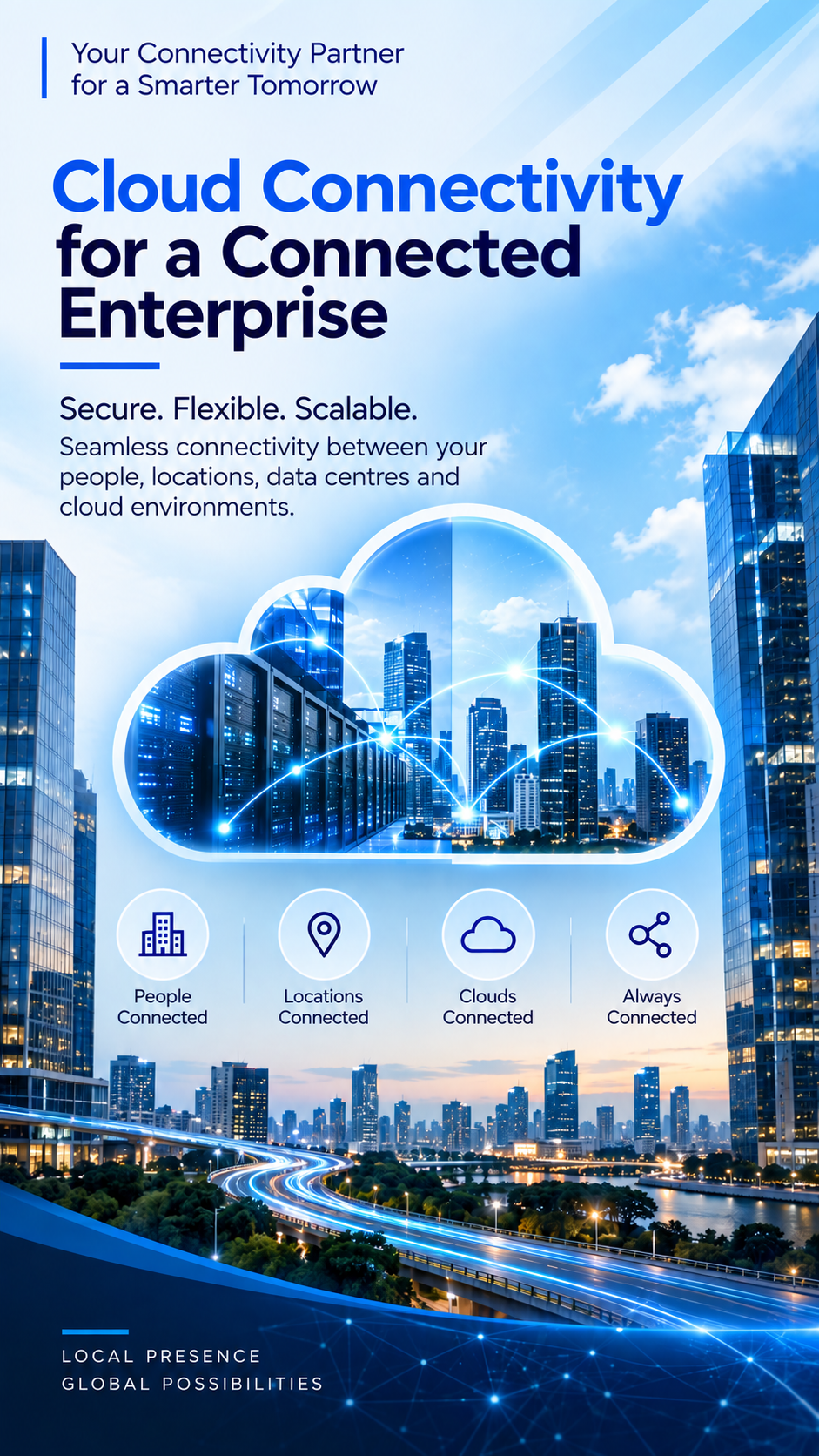
Cloud Connectivity links an enterprise network to public, private, hybrid or multi-cloud environments. A connection can originate at a head office, branch, campus, data centre or colocation facility, either directly or through an existing enterprise WAN.
Private connectivity provides a network path to eligible cloud services that avoids public internet transit. Dedicated capacity describes the bandwidth or port allocated to a service; it does not necessarily mean a separate physical fibre from end to end. The access model, handover and cloud-side reachability must be defined together.
Enterprises use these connections to control routing, plan capacity and reduce dependence on variable public internet paths for selected workloads. Internet access may still be required for SaaS, public endpoints, management services or a separately designed backup. Performance depends on the complete path and the application.
Where It Fits
- Internet Leased Line provides enterprise internet access and can carry an encrypted VPN or a separately planned cloud backup path.
- Point-to-Point Connectivity can connect a site to a data centre or an agreed cloud access location; it does not by itself configure cloud access.
- MPLS VPN can bring multiple sites to a cloud gateway with defined routing and segmentation.
- SD-WAN can steer branch traffic across available underlays towards cloud gateways and apply application policies.
- Colocation can provide a physical aggregation point for enterprise equipment and cloud cross-connects, subject to facility and interconnect availability.
Cloud Connectivity Capabilities
Private and Dedicated Cloud Access
Define a private path and the required service capacity between enterprise and cloud endpoints. Confirm the access location, handover and eligible cloud services before selecting a connection.
Hybrid Cloud Connectivity
Connect on-premises applications and data with cloud workloads. Plan addressing, DNS, routing and security policies so both environments can communicate within agreed boundaries.
Multi-Cloud Connectivity
Plan access to more than one cloud environment with separate routing and security requirements. Validate each destination and any cloud-to-cloud transit requirement independently.
Data Centre to Cloud
Connect data centre or colocation infrastructure to a cloud access point. Coordinate facility cross-connects, interfaces, cloud attachments and transfer capacity for the intended workloads.
Enterprise WAN Integration
Integrate cloud access with MPLS VPN, SD-WAN or dedicated site connectivity. Define which branches use each gateway, which prefixes are reachable and who manages routing changes.
Resilience and Path Diversity
Assess a secondary path against shared failure risks, including building entry, fibre route, equipment, power and cloud edge. Confirm the achievable diversity and test failover before acceptance.
Cloud Connectivity Architecture
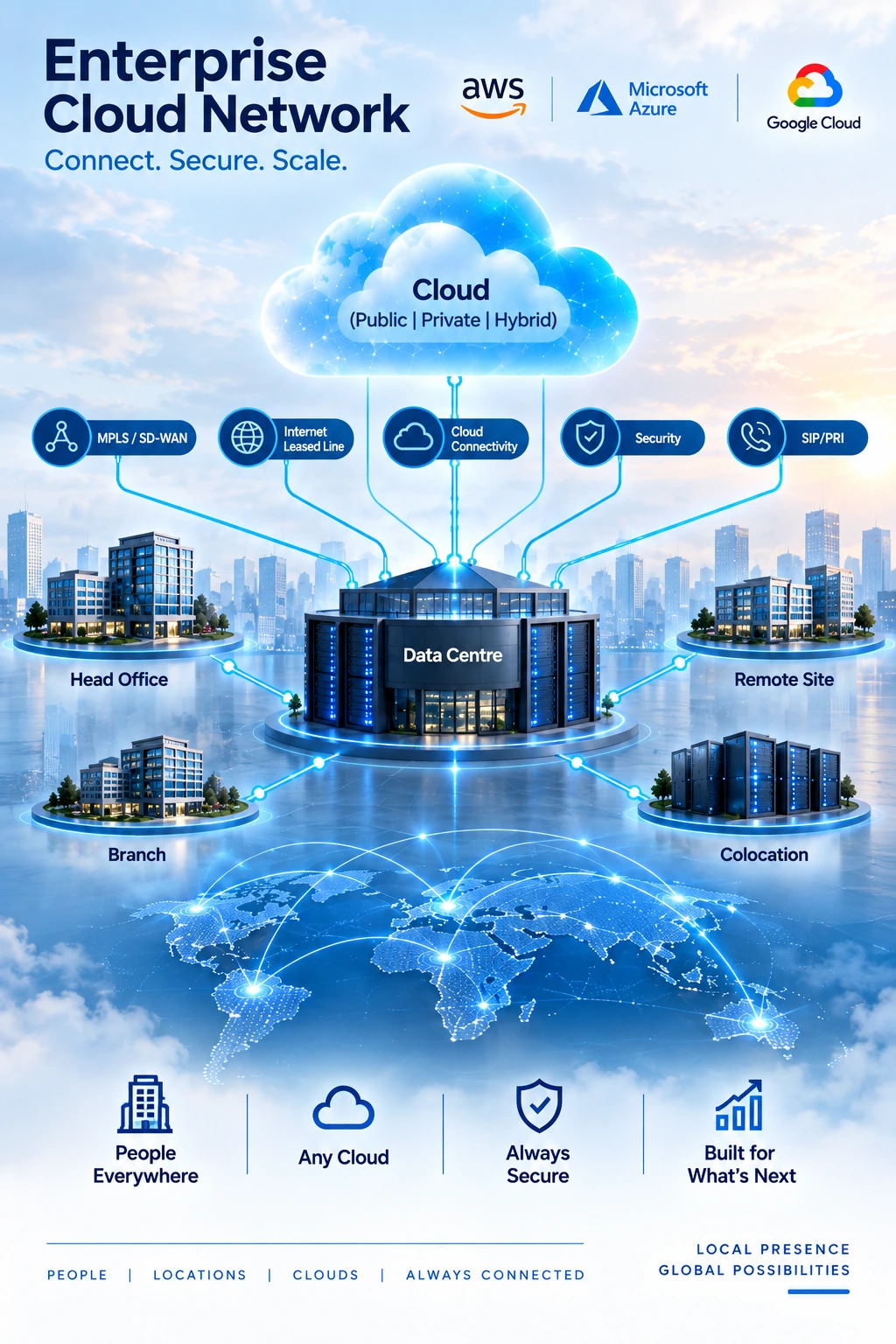
Design from the Enterprise Edge to the Cloud
Endpoints and capacity. Identify source sites, destination cloud networks and the relevant region. Size bandwidth from concurrent application demand, transfer volumes, backup windows and growth, allowing for overhead and reduced capacity during failover. Confirm the handoff speed, medium, MTU and any facility cross-connect.
Handover and routing. With Layer 2 transport, the enterprise may manage routing to the cloud edge. With a managed Layer 3 service, a provider may manage part of that routing. Agree VLAN tags, interfaces, non-overlapping IP ranges, peer addresses, ASNs, route filters and return paths. BGP is commonly required at cloud interconnects; static routing is suitable only on segments and service models that support it.
Cloud-side readiness. The cloud account owner must authorise and configure the required connection, virtual interface or attachment, gateway, route tables and workload access policies. Check region and service eligibility, DNS resolution, quotas and any private endpoint requirements. Network connectivity alone does not make every cloud service privately reachable.
Security boundaries. Private transport is not encryption by default. Apply segmentation, least-privilege firewall rules and route controls. Assess TLS or IPsec for traffic protection and MACsec only where supported; confirm its link-level scope. Agree responsibility for cloud security groups, firewalls and management access.
Resilience and operations. Document primary and secondary paths, shared infrastructure and routing behaviour. Separate VLANs or two circuits do not prove physical diversity. Define monitoring, fault demarcation, support hours and escalation ownership. Measure latency, loss and throughput between agreed endpoints and test failover and recovery against the accepted design.
Enterprise Use Cases
These patterns are relevant to technology firms, healthcare organisations, banks, NBFCs, insurers, FMCG businesses, manufacturers, professional services firms and other multi-location enterprises. Select the design by workload and operating requirements.
Private Access to Business Applications
Connect enterprise users to eligible cloud-hosted ERP, databases and internal applications. Define reachable networks, DNS and security policies for controlled access.
Data Centre Extension and Hybrid Workloads
Link retained data centre systems with applications running in the cloud. Assess dependency latency, addressing and security boundaries before splitting a workload across environments.
Multi-Cloud Enterprise Environments
Provide enterprise access to workloads across separate cloud platforms or regions. Design each route and any transit service explicitly, with clear operational ownership.
Backup, Recovery and Replication
Plan transfer capacity around backup windows, data change rates and recovery objectives. Test restoration traffic and remaining capacity when a connection fails.
Branch Access to Cloud Workloads
Connect distributed offices through the enterprise WAN or suitable local cloud access. Assess gateway placement, branch bandwidth and SD-WAN or MPLS integration.
Cloud Migration and Bulk Data Transfer
Plan initial data movement and synchronisation during migration. Check usable throughput, transfer windows, cloud-side limits and the connectivity needed after cutover.
Deployment and Feasibility
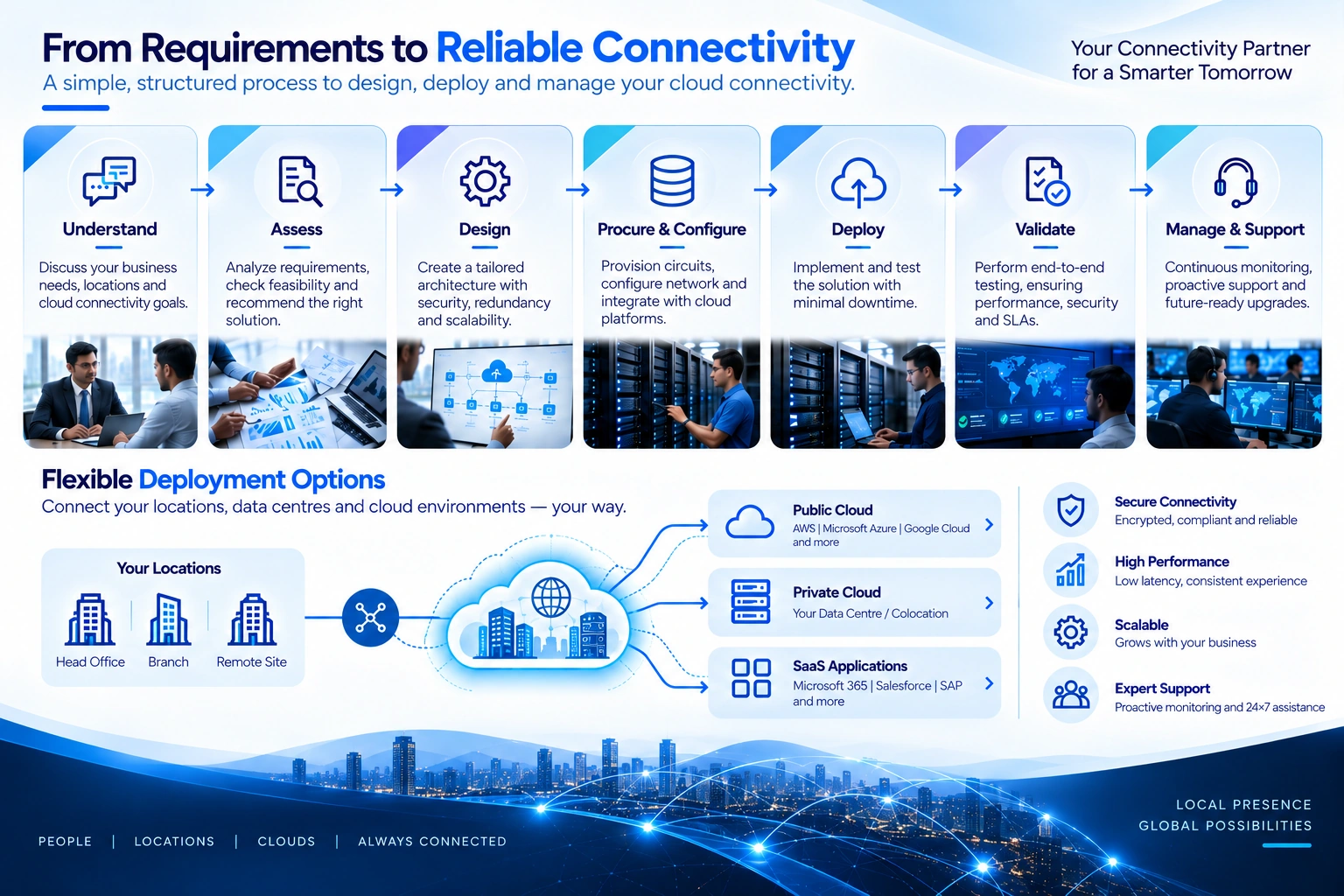
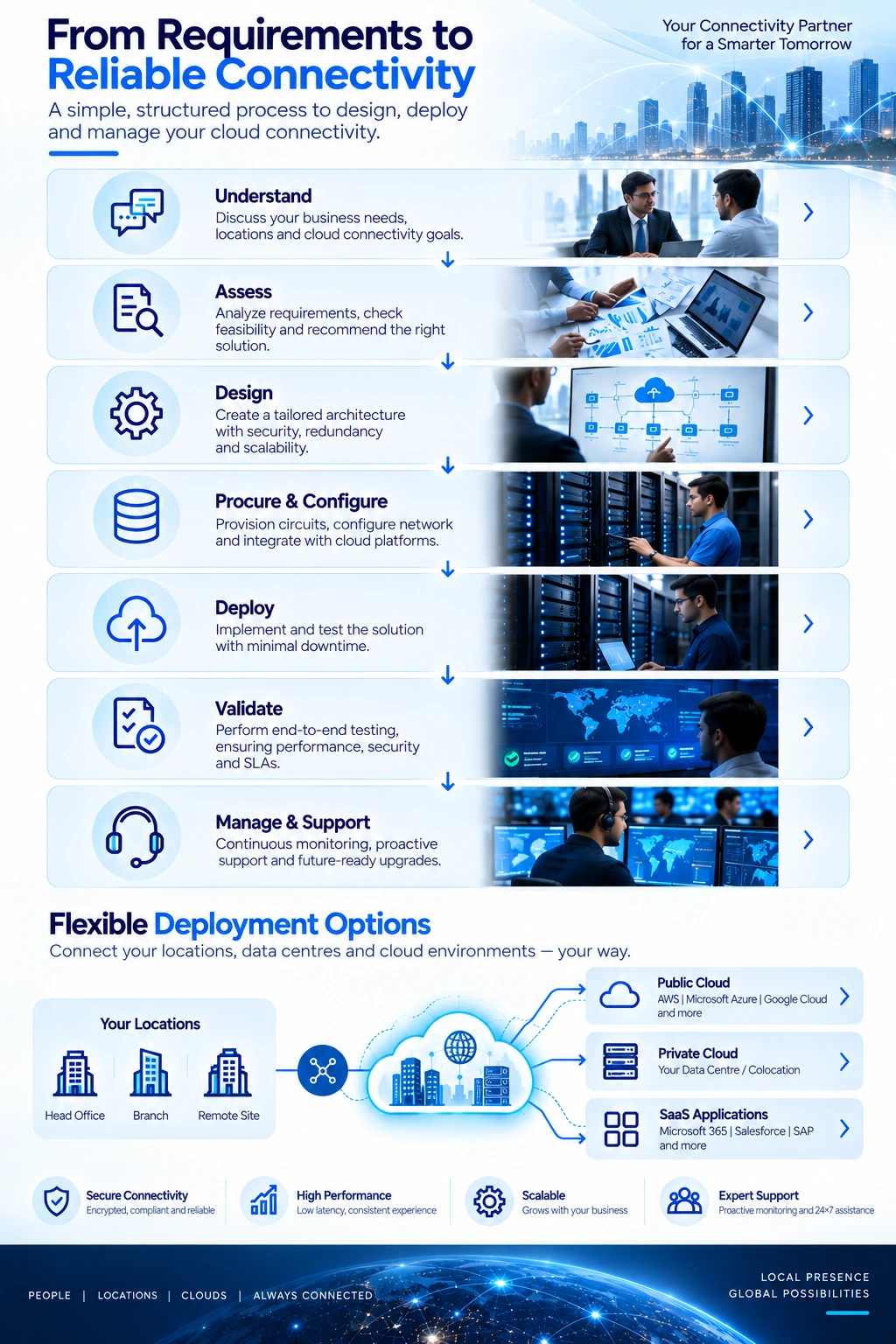
Requirements Discovery
Share the source City / Area / Location and PIN Code, site count, workloads, required bandwidth or traffic estimates, cloud environment and preferred region. Identify resilience needs and the business target date. Full installation addresses are collected later during feasibility or order processing.
Endpoint and Cloud Environment Validation
Confirm the enterprise handover, cloud account ownership, destination networks, region and eligible connection model. Identify the teams responsible for cloud approvals, gateways, interfaces and workload access.
Feasibility and Access Design
Check access availability, facility entry, cloud on-ramp reach, interface compatibility, cross-connects and capacity. Establish a lead-time estimate only after dependencies and service feasibility are understood.
Routing, Security and Resilience Design
Agree Layer 2 or Layer 3 handover, VLANs, addressing, BGP or permitted static routes, route filtering and security controls. Document primary and secondary paths, shared risks and the acceptance plan.
Provisioning and Configuration
Coordinate access delivery, facility work, cloud attachments and enterprise configuration with the responsible teams. Track approvals, change windows and readiness on both sides before activating traffic.
Testing, Acceptance and Handover
Verify link and routing status, allowed reachability, DNS, MTU, representative throughput, latency and packet loss. Test failover and recovery where ordered. Handover includes results, the agreed topology, configuration ownership, monitoring scope and escalation contacts.
Why CloudShots Technologies
Architecture-Led Assessment
Start with workloads, endpoints, routing and operating requirements. Translate them into a connectivity scope that network teams and procurement can evaluate together.
Provider-Neutral Design
Assess connectivity options against feasibility, service boundaries and the required architecture. Define the basis for selection without assuming a particular carrier or cloud platform.
Integration Across Enterprise Services
Plan cloud connectivity alongside Internet Leased Line, Point-to-Point Connectivity, MPLS VPN, SD-WAN and colocation requirements to make handovers and dependencies explicit.
Deployment and Operational Coordination
Coordinate feasibility, implementation dependencies, acceptance and escalation responsibilities. Agree support scope and ownership as part of the service proposal.
Cloud Connectivity FAQs
Provide the source City / Area / Location and PIN Code, cloud environment and region if known, required bandwidth or workload estimates, existing WAN and redundancy needs. Full installation addresses are collected later. Lead time depends on access availability, site and facility permissions, equipment, cross-connects, cloud approvals and configuration readiness. A deployment estimate follows feasibility; there is no universal activation timeline.
Two connections can still share fibre ducts, building entry, equipment, power or a cloud edge. Assess physical and logical separation across the complete path, document residual shared risks and size the surviving connection for the required load. Validate failover and recovery; diversity and performance commitments must be confirmed in the service design.
The service model determines the handover and routing responsibilities. Layer 2 transport can carry enterprise-to-cloud routing, while a managed Layer 3 service may place cloud-side BGP with the provider. BGP is commonly required at cloud interconnects. Static routes may be supported on a customer-facing segment but cannot replace cloud-side BGP where the platform requires it. VLANs, ASNs, IP ranges and route policies must be agreed.
Start with concurrent application demand, traffic measurements, data change rates and transfer windows. Include growth, protocol overhead and the load that must run on a surviving path. Port speed, purchased service capacity and achievable application throughput are different measures. If bandwidth is unknown, share workload and transfer estimates for assessment.
Public, private, hybrid and multi-cloud environments can be assessed. AWS, Microsoft Azure, Google Cloud and Oracle Cloud are examples of destination platforms, not claims of partnership or universal availability. Feasibility depends on the source location, access network, cloud interconnect location, region, service eligibility and cloud-side configuration.
An Internet Leased Line provides dedicated enterprise access to the public internet. Private Cloud Connectivity establishes a defined path to eligible cloud networks or services without public internet transit. An internet circuit can still support SaaS access, an encrypted VPN or a separately designed backup. Private transport does not automatically encrypt traffic.
Plan Your Cloud Connectivity
Share your source location, cloud environment and bandwidth requirement. CloudShots Technologies will review feasibility, routing, resilience and the dependencies needed to connect your enterprise network to the cloud.
At this stage, provide City / Area / Location and PIN Code only. Full installation addresses are collected later during feasibility or order processing.