
Colocation2026-09-16T18:52:45+05:30

ENTERPRISE COLOCATION

Colocation Services for Secure Enterprise Infrastructure

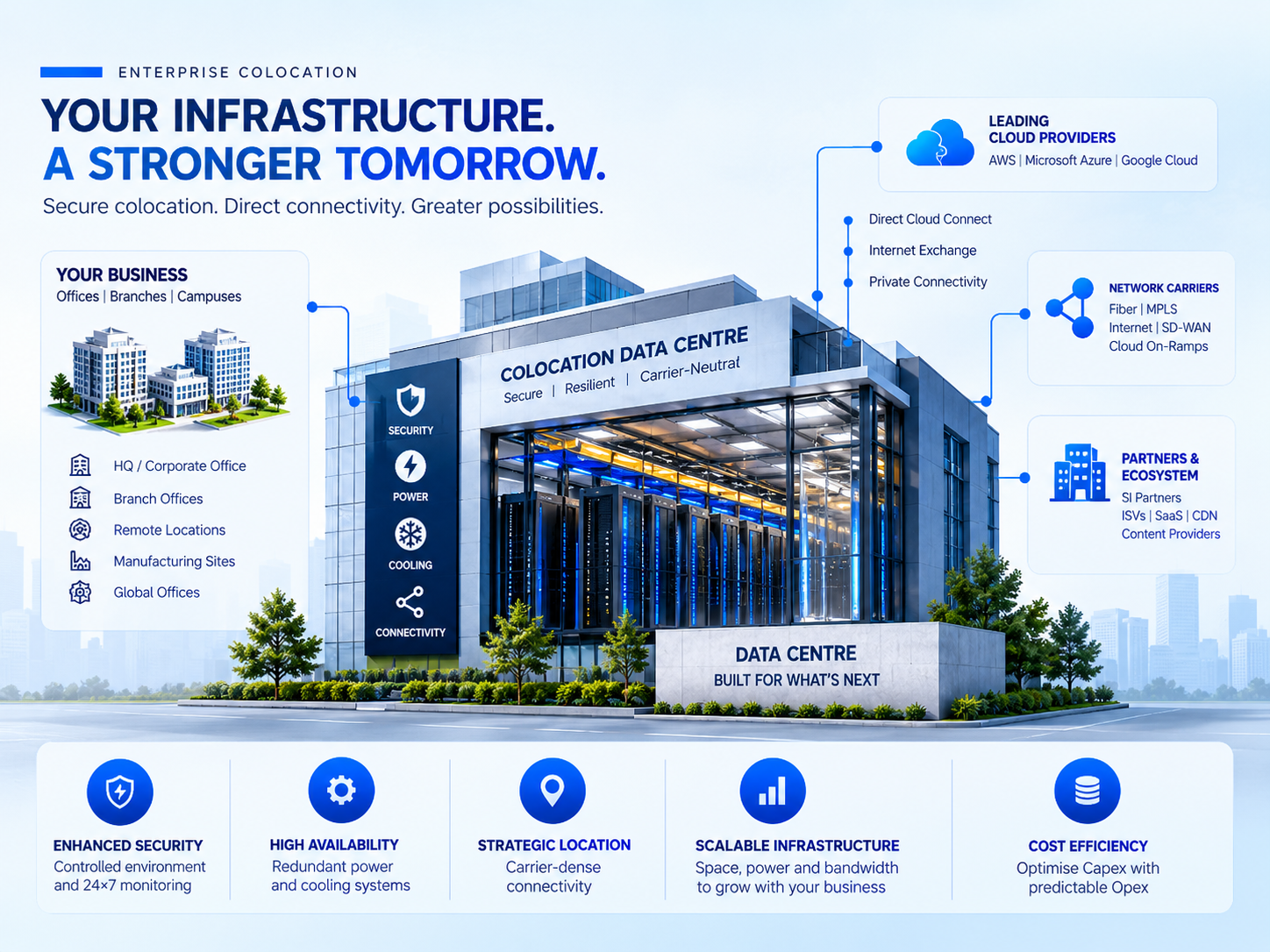
Colocation services allow enterprises to place servers, network appliances and related IT infrastructure in professionally operated data-centre facilities with appropriate power, cooling, physical security and connectivity arrangements.
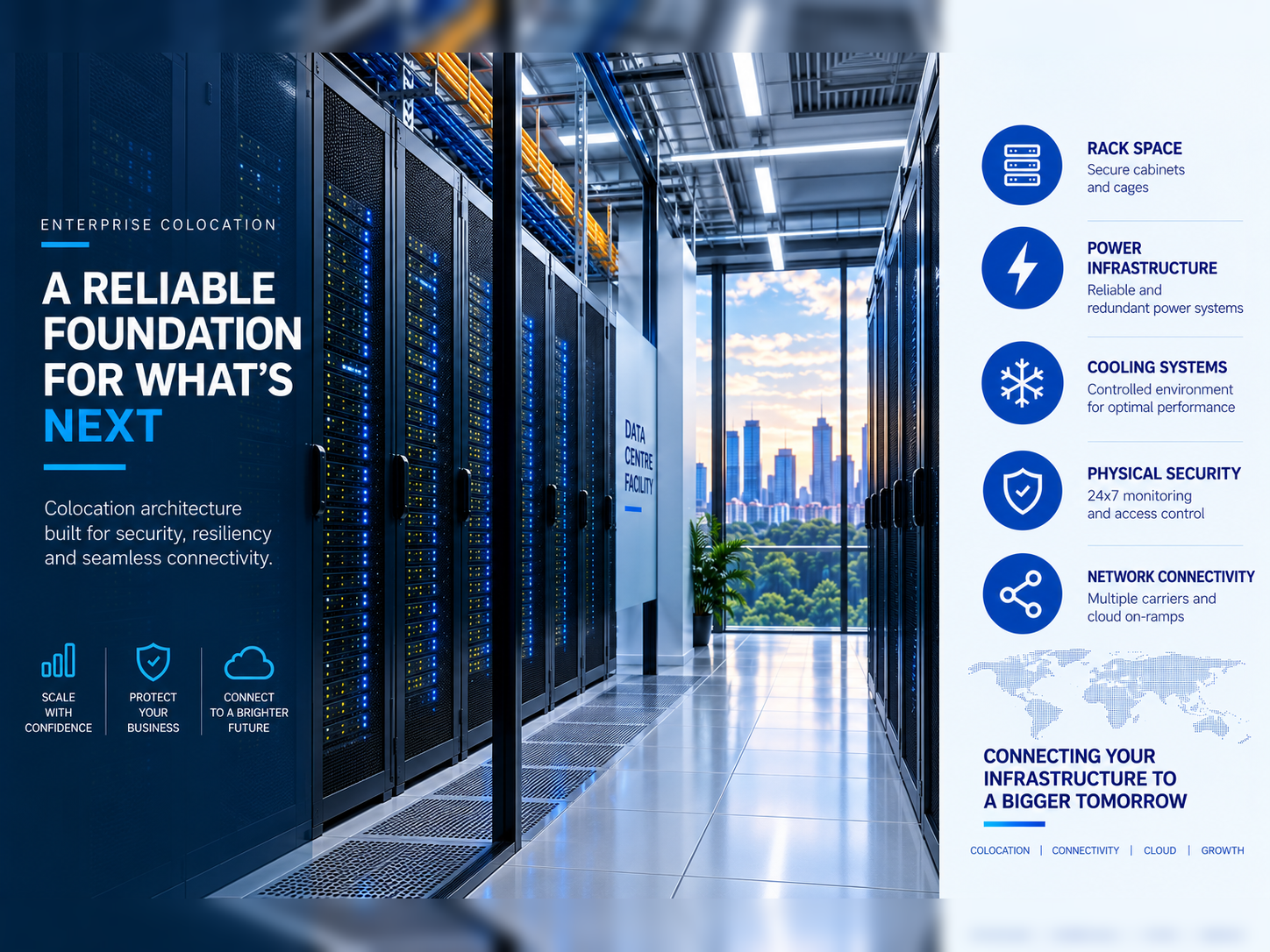
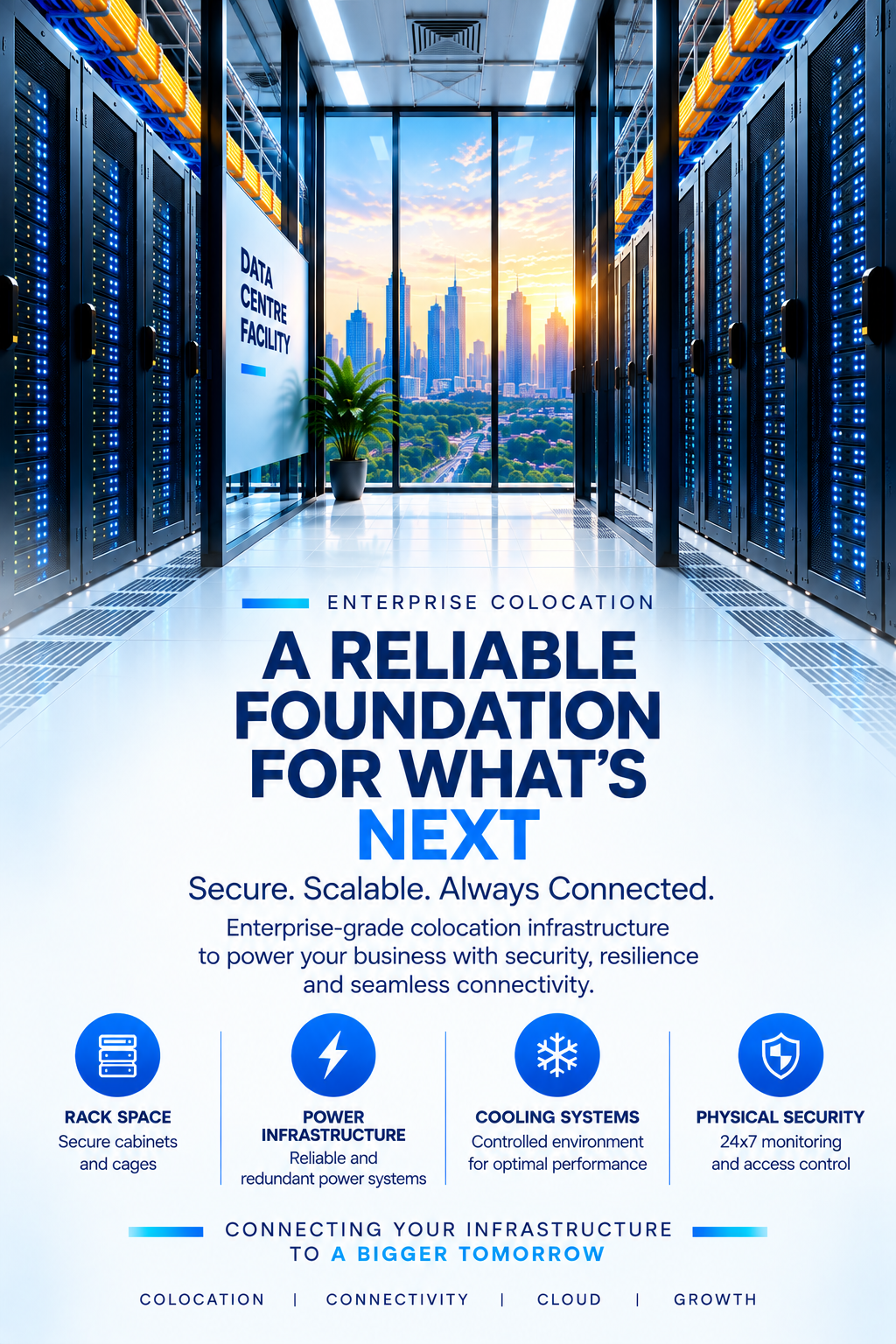
Enterprise colocation services and data centre infrastructure

What Are Colocation Services?

Colocation enables enterprises to place their own servers, network equipment and related IT infrastructure in a professionally managed data-centre environment rather than operating all supporting facility infrastructure themselves.

The enterprise may retain ownership and operational control of its equipment. The facility/provider arrangement may provide rack or cabinet space, power, cooling, physical security, connectivity, cross-connects and selected operational services.

Actual service scope varies by facility and commercial arrangement. Define equipment management, facility responsibilities and support boundaries before deployment.

Where It Fits

  • Primary infrastructure
  • Disaster recovery
  • Network point of presence
  • Hybrid cloud architecture
  • Cloud on-ramp / connectivity requirements
  • Server-room consolidation
  • Geographic resilience
  • High-availability applications

Colocation Capabilities

Facility capability depends on location, available data centre, rack requirements, power density, cooling, physical access, connectivity and provider availability.

Rack and Cabinet Options

Plan rack-unit, partial rack, full cabinet or other appropriate allocations against equipment dimensions, growth needs and facility availability.

Power and Redundancy

Evaluate power allocation, equipment consumption, PDU requirements and A/B feeds where available. Match the power topology to the required equipment redundancy.

Cooling and Environmental Controls

Review facility cooling, environmental monitoring and supported power density to assess suitability for the proposed enterprise infrastructure.

Carrier-Neutral Connectivity

Evaluate carriers, cross-connects, Internet Leased Line, Point-to-Point, MPLS/SD-WAN and cloud access, subject to location and provider availability.

Physical Security and Access

Review access control, surveillance, visitor authorisation and equipment-handling procedures according to the selected facility’s security processes.

Remote Hands and Operational Support

Coordinate remote-hands or smart-hands tasks, equipment access and escalation. Availability, response windows and permitted activities depend on the agreed provider scope.

Colocation Architecture

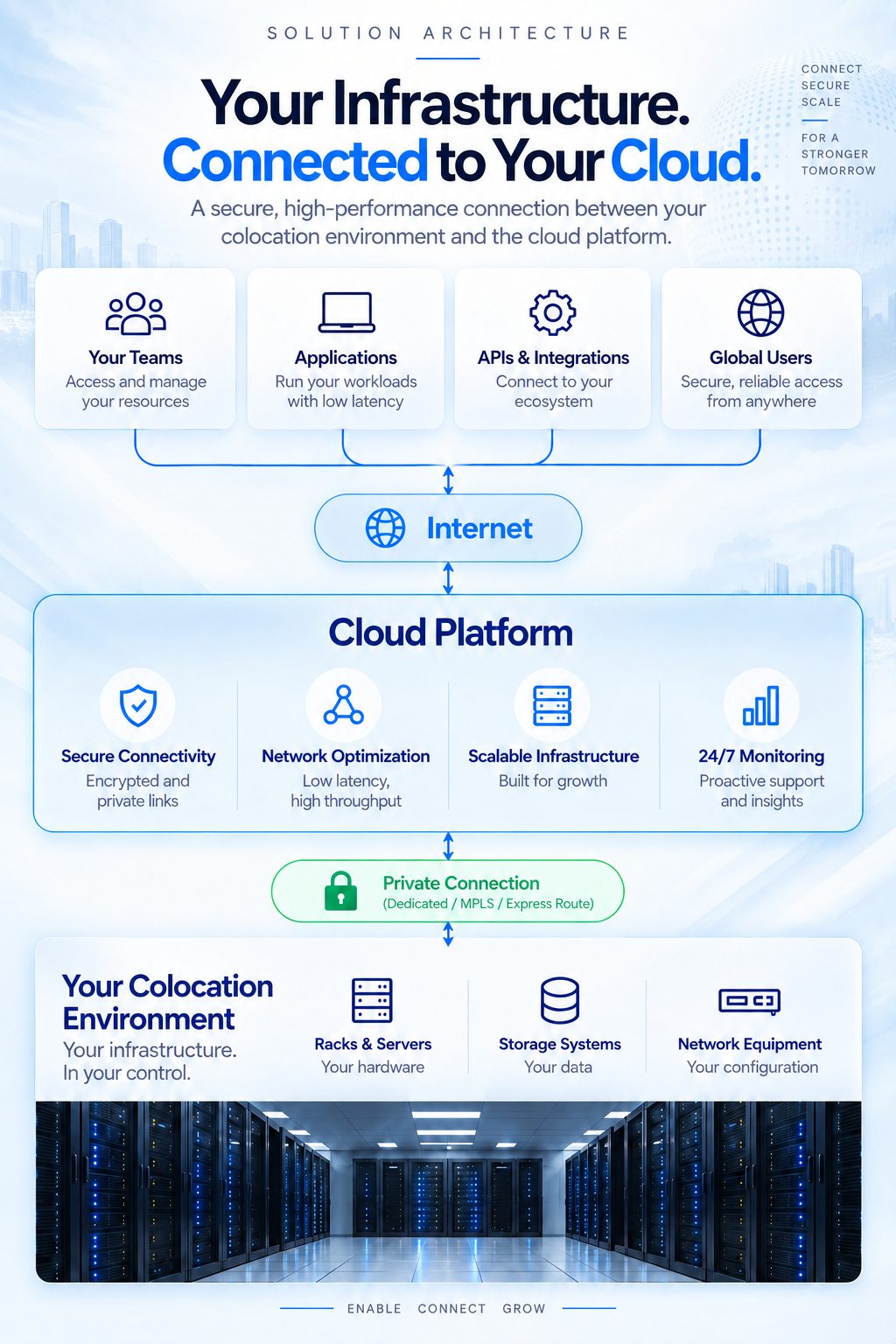
Enterprise colocation architecture with rack power and network connectivity

Design from Rack, Power and Connectivity Dependencies Inward

Start with the customer equipment, rack or cabinet requirement, power density and cooling needs. Validate PDUs, A/B power where appropriate, and the local switches, routers and firewalls that support the workload.

Map carrier cross-connects, internet or private connectivity and cloud access to the required interfaces and routing. Define monitoring, remote hands, physical access and operational responsibilities alongside resilience requirements.

A second telecom circuit does not automatically create real path diversity. Evaluate carrier diversity, entry paths, meet-me-room design and shared infrastructure rather than assuming independence.

A/B power availability does not guarantee end-to-end equipment resilience. Review power topology, equipment architecture and failure behaviour as a complete system.

Enterprise Use Cases

Use professionally managed facility infrastructure while retaining control of important IT and network assets, or integrating them with WAN and cloud environments.

Primary Data Centre Infrastructure

House business-critical servers and network equipment in a facility selected for the workload’s power, cooling, connectivity and access needs.

Disaster Recovery Site

Place recovery infrastructure at a separately evaluated location. Confirm replication paths, recovery objectives, shared risks and recovery testing responsibilities.

Network Point of Presence

Establish a network aggregation or interconnection point with suitable rack space, carrier access, cross-connects and operational support.

Hybrid Cloud Infrastructure

Integrate customer-owned infrastructure with cloud workloads through appropriate network paths, routing, security controls and cloud access arrangements.

Server-Room Consolidation

Consolidate distributed equipment into a suitable facility while planning migration windows, dependencies, remote access and ongoing ownership.

Latency, Resilience or Compliance-Led Deployment

Evaluate geography, measured network paths, failure domains and applicable business requirements. Verify facility evidence against specific compliance needs.

Deployment and Feasibility

Validate facility, power, network and operational dependencies before agreeing the deployment scope and schedule.
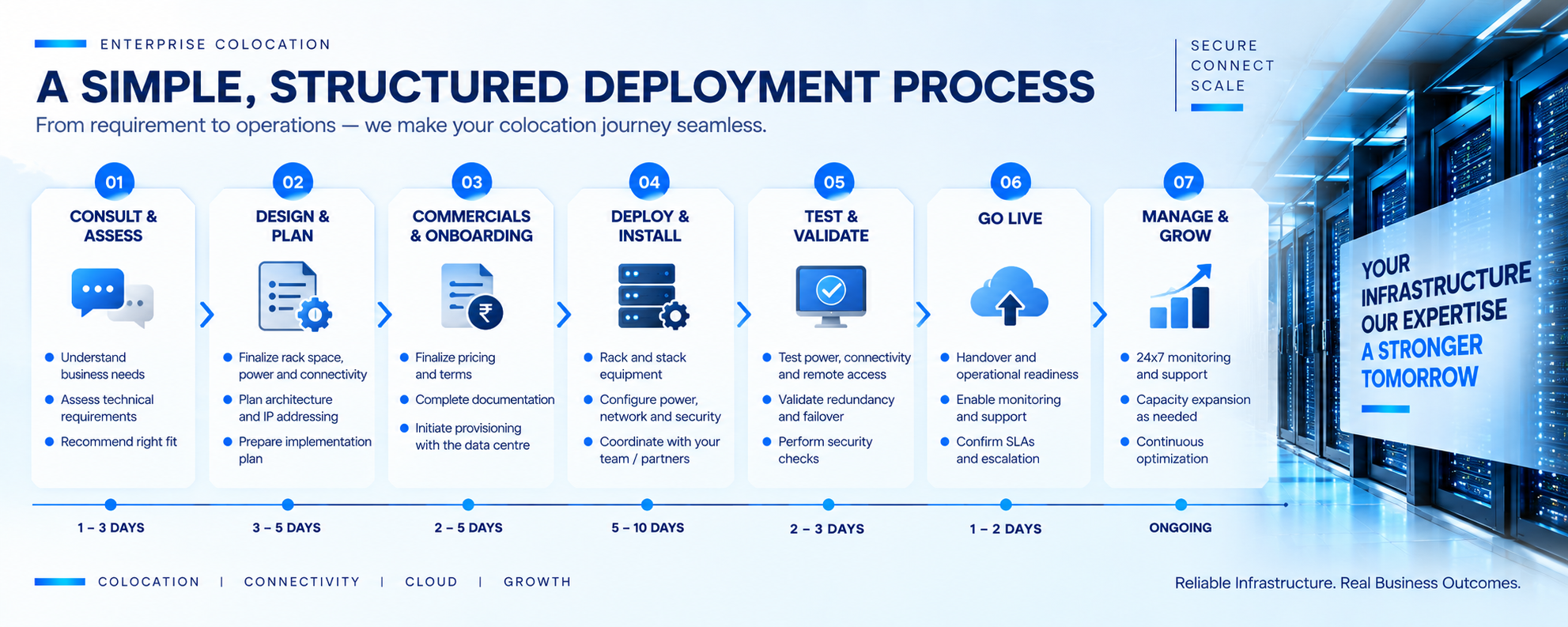
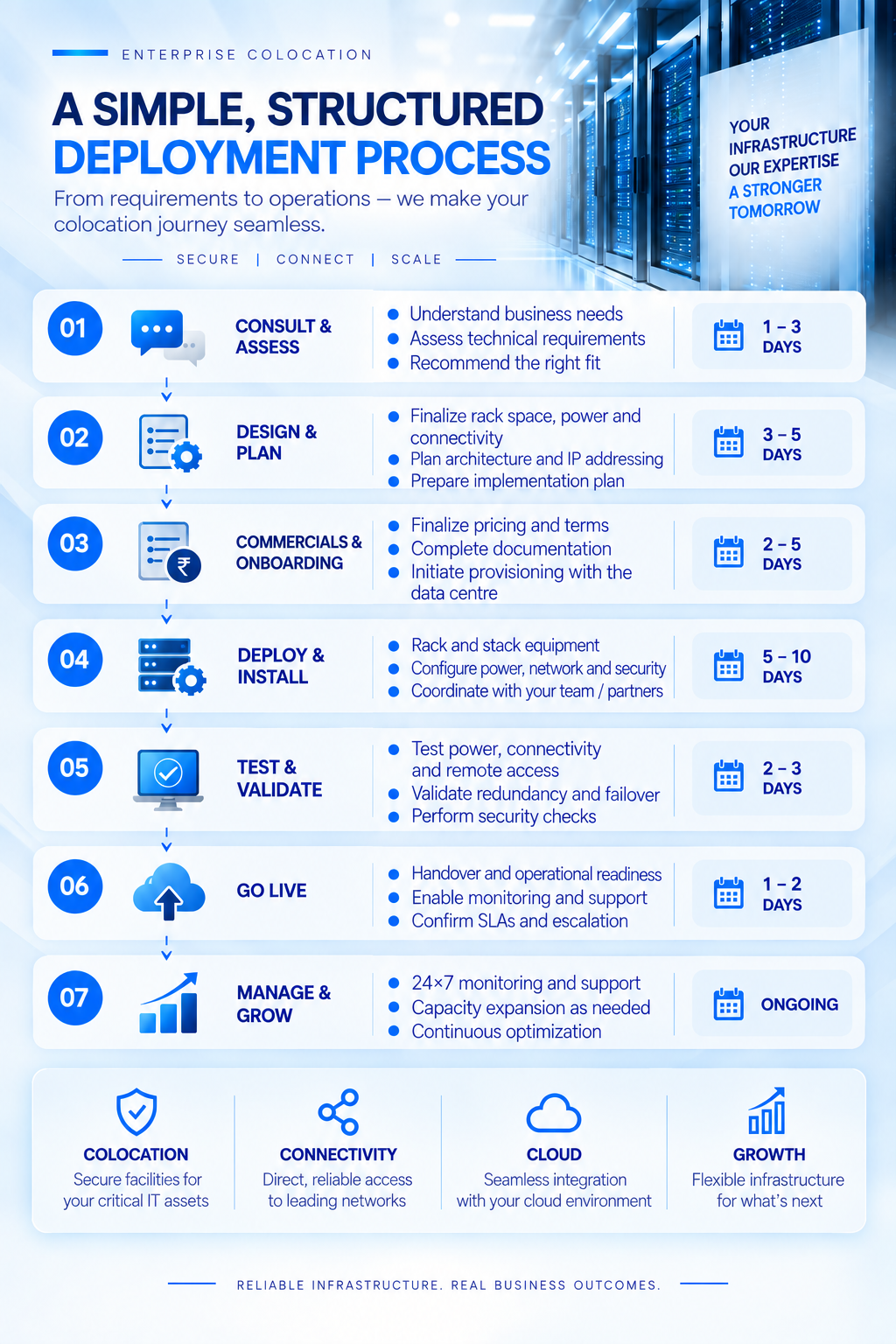
Colocation deployment and feasibility process

01

Requirements Discovery

Capture City / Area / Location Name + Postal pincode, rack or cabinet needs, equipment footprint, approximate power, connectivity, resilience, access and operational support requirements.

02

Facility and Location Evaluation

Assess facility options, geographic requirements, provider availability, practical access and business needs before narrowing the deployment location.

03

Rack, Power and Cooling Validation

Confirm rack units, cabinet allocation, power feeds, estimated consumption, power density, cooling suitability and facility constraints.

04

Connectivity and Cross-Connect Design

Evaluate carriers, Internet Leased Line, private circuits, MPLS/SD-WAN, cloud connectivity, cross-connects, handoff interfaces and route-diversity requirements.

05

Provisioning, Migration and Installation

Coordinate rack readiness, power, cross-connects, equipment movement and installation windows. Assign customer and provider responsibilities before migration.

06

Testing, Acceptance and Handover

Validate power, network connectivity, monitoring, remote access and application reachability. Complete documentation, support contacts and operational handover.

07

Manage & Grow

Support ongoing operations, capacity expansion, additional connectivity and infrastructure changes as business requirements evolve.

Deployment timelines depend on facility availability, equipment readiness, connectivity feasibility and customer requirements.

For initial website feasibility, provide City / Area / Location Name + Pincode. A complete street installation address can be collected later during feasibility or order processing.

Why CloudShots Technologies

CloudShots helps coordinate colocation services by keeping facility, network, cloud and operational requirements connected throughout evaluation and implementation.

Requirements-Led Planning

Start with workloads, equipment, rack space, power, connectivity, resilience and operational requirements before selecting an implementation.

Provider-Neutral Coordination

Evaluate practical facility and connectivity options against the requirement. A single provider or facility will not suit every deployment.

Integration Across Network and Cloud Services

Coordinate Point-to-Point Connectivity, MPLS VPN, SD-WAN, Cloud Connectivity, internet access, firewall and enterprise networking where relevant.

Deployment and Operational Coordination

Clarify customer and provider responsibilities across provisioning, installation, cross-connects, testing, escalation and operational handover.

Colocation FAQs

Common questions about equipment, facilities, connectivity and deployment feasibility.

What is colocation?2026-09-12T18:04:52+05:30

Colocation places enterprise-owned servers and network equipment in a professionally managed data-centre facility. Rack space, power, cooling, physical security, connectivity and operational services depend on the selected facility and agreement. The enterprise may retain equipment ownership and operational control.

What equipment can be placed in a colocation facility?2026-09-12T18:05:35+05:30

Servers, storage, switches, routers, firewalls and related IT equipment may be accommodated. Eligibility depends on dimensions, mounting, weight, power consumption, cooling needs and the facility’s equipment policies.

What rack or cabinet options are available?2026-09-12T18:06:15+05:30

Options may include rack units, a partial rack, a full cabinet or another agreed allocation. Availability, access arrangements, usable space and expansion options must be confirmed with the facility.

How are power and cooling requirements determined?2026-09-12T18:06:48+05:30

Review equipment specifications, expected consumption, peak demand, growth, power density and redundancy needs. Validate feed capacity, PDUs, cooling suitability and facility constraints before agreeing the allocation.

Can we use our preferred telecom carrier?2026-09-12T18:19:09+05:30

Potentially, where the carrier is available at the selected facility and an appropriate connection can be arranged. Confirm presence, cross-connect options, handoff, capacity, commercial terms and delivery dependencies during feasibility.

What is a data-centre cross-connect?2026-09-12T18:19:37+05:30

A cross-connect is a physical link within a facility between defined termination points, such as customer equipment and a carrier or interconnection service. The medium, interface, route, charges and responsibilities must be agreed. It does not by itself provide an end-to-end network service.

Can colocation connect directly to public cloud environments?2026-09-12T18:20:00+05:30

Dedicated or private cloud access may be possible through eligible carriers or interconnection providers. Confirm cloud region and service availability, facility access, cross-connects, routing, capacity and cloud-side configuration. A rack allocation alone does not establish cloud connectivity.

Can redundant power and network paths be designed?2026-09-12T18:20:24+05:30

Options may include A/B feeds and separately evaluated network paths. A/B power does not guarantee end-to-end equipment resilience, and a second circuit does not prove route diversity. Review shared equipment, entry paths, meet-me rooms and power topology, then test the agreed design.

What remote-hands support may be available?2026-09-12T18:20:53+05:30

Providers may offer agreed physical tasks such as visual checks, cable handling or controlled equipment operations. Confirm permitted activities, authorisation, availability, response windows, charges and escalation; application administration may require a separate scope.

What information is required for initial colocation feasibility?2026-09-13T22:29:11+05:30

Provide City / Area / Location Name + Pincode, equipment footprint, rack or cabinet needs, approximate power, connectivity, resilience, access, operational support and target timing. A complete street installation address can be collected later during feasibility or order processing.

How long can a colocation deployment take?2026-09-12T18:21:45+05:30

Timing depends on facility capacity, rack and power readiness, carrier provisioning, cross-connects, equipment logistics, approvals and migration windows. A practical schedule follows feasibility and agreement of customer and provider responsibilities.

Plan Your Colocation Deployment

Discuss your target location, equipment, rack space, power, connectivity and operational needs. CloudShots Technologies can help organise the technical and commercial inputs for a practical feasibility review.

For initial location details, City / Area / Location Name + Pincode is sufficient.

Go to Top