

Cloud Telephony for Modern Business Communications
Cloud Telephony centralises business calling, extensions and call routing in a hosted platform rather than relying entirely on an on-premise PBX. Enterprise users can connect through supported desk phones, softphones, mobile applications or browser-based clients, depending on the selected platform and service design.
For CIOs, IT leaders, unified communications teams and procurement managers, Cloud Telephony is an operating-model decision as much as a voice-service decision. A sound transition reviews users, locations, DID numbers, concurrent calls, IVR and queue requirements, connectivity, security, integrations, continuity and migration dependencies before selecting a platform.

Enterprise Cloud Telephony Overview
Cloud Telephony is a hosted business voice model in which call control, extension management, IVR, queues and related administration are delivered from a provider platform. The platform receives or originates calls, applies configured routing, connects users and records operational data according to the enabled service features.
Unlike a traditional on-premise PBX, the organisation does not need to operate every call-control component at each site. Administration can be centralised across offices and user groups. The service still depends on suitable endpoints, LAN and Wi-Fi quality, firewall policy, enterprise connectivity, identity controls and a support model that covers both the platform and the access path.
Cloud Telephony may replace some PBX functions, coexist with PRI during transition, or integrate with a SIP Trunk design. These models are not automatically interchangeable; the appropriate option depends on control, compatibility, regulatory, feature and migration requirements.
Business Outcomes
Simplified communications management: Apply extension, routing and policy changes through a central administration model instead of maintaining separate PBX configurations at every location.
Multi-location collaboration: Connect offices and user groups to one governed calling environment while retaining location-specific call flows where required.
Workforce flexibility: Support authorised office, remote and mobile users through suitable devices and applications, subject to platform capability and security policy.
Scalable voice operations: Add users, DIDs, queues and routing policies through planned capacity and licensing changes rather than assuming a fixed physical trunk model.
Key Cloud Telephony Capabilities
Cloud Telephony capabilities should be evaluated against actual call flows, user roles, integrations and continuity requirements. Feature names may look similar across platforms, but administration depth, routing logic, reporting, recording, integration and support responsibilities can differ.
01
Cloud-Hosted PBX
Centralise extension, dial-plan and calling-feature administration in a hosted environment, depending on the selected platform and service design.
02
DID and Extension Management
Map business numbers to users, departments, IVR menus, queues and fallback destinations with documented ownership and change controls.
03
IVR and Automated Routing
Direct callers by business hours, language, department, skill, queue condition or fallback rule where the platform supports the required logic.
04
Queues and Hunt Groups
Distribute calls across defined teams using ring strategies, wait treatment, overflow and supervisor controls appropriate to the operating model.
05
Remote and Mobile Calling
Extend authorised business calling to softphones, mobile users or supported browser clients with identity, endpoint and network controls.
06
Recording and Analytics
Use recording, reporting and call analytics where supported and configured, with access, retention, consent and compliance requirements reviewed separately.
07
CRM and Application Integration
Connect calling workflows with customer, service or contact-centre applications when supported APIs, connectors and data controls meet the requirement.
08
Continuity and Failover
Define alternate routing, device options, location failover and recovery responsibilities for access-link, site, endpoint or platform disruption.
Architecture and Design
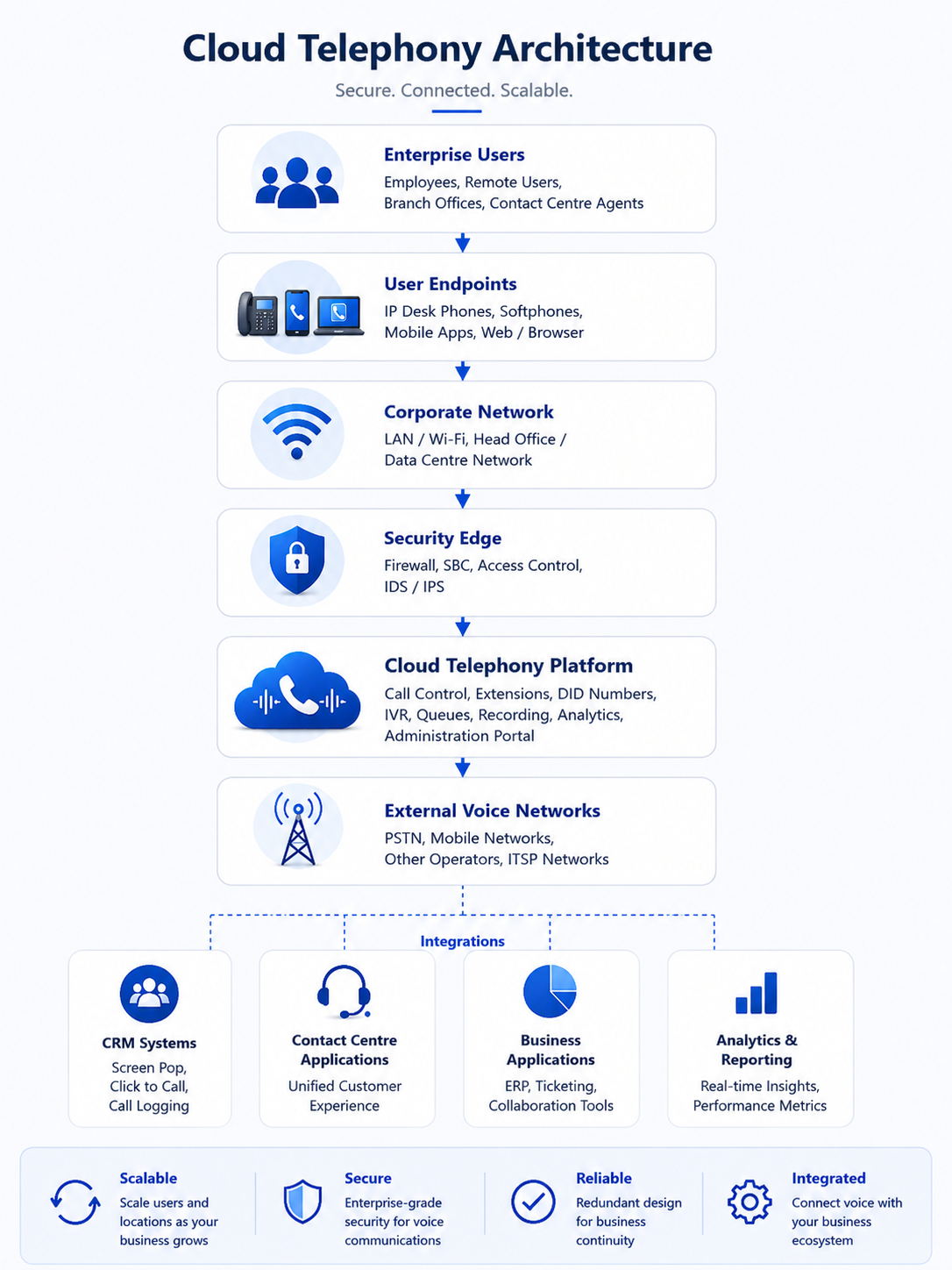
A production Cloud Telephony design begins with enterprise users and their supported endpoints. Desk phones, softphones and mobile clients reach the hosted voice platform through the LAN or Wi-Fi network, firewall and security edge, and an appropriate enterprise connectivity service. The platform applies call-control and routing policies before calls reach external voice networks, other users or integrated applications.
Connectivity and QoS: Voice quality depends on the complete path, including endpoint condition, LAN contention, wireless coverage, access-link stability, latency, jitter, packet loss, firewall handling and provider routing. An Internet Leased Line, SD-WAN or another suitable enterprise access design may improve control, but no access service fixes an unmanaged LAN or incorrect firewall policy by itself. For branch-heavy environments, MPLS VPN may remain relevant in a hybrid WAN where private traffic and cloud voice use different paths.
Security and SBC considerations: Review authentication, role-based administration, endpoint registration, encryption availability, firewall policy, fraud controls, logging and Session Border Controller requirements where applicable. Recording and analytics data require separate access, retention and privacy controls.
Migration and coexistence: Existing PRI, PBX and SIP environments may remain during a phased transition. Number movement, route testing, rollback and business-hours planning should be agreed before production cutover.
Enterprise Use Cases and Industries
Cloud Telephony is most useful when an organisation needs a centrally managed calling model across locations, workforce types or customer-service teams. Suitability depends on the required call flows, integration depth, device model, connectivity and control requirements rather than industry name alone.
Multi-Location Enterprise Communications
Manage extensions, business numbers and routing across offices while applying local schedules, departments and fallback rules where required.
Hybrid and Remote Workforce
Provide authorised users with consistent business calling through supported desk, softphone or mobile clients while preserving identity and access controls.
Customer Service and Contact Centres
Coordinate IVR, queues, recording, analytics, CRM integration and supervisor workflows according to concurrency and service-level needs.
PBX and PRI Modernisation
Use pilots, number mapping, coexistence and rollback planning to move suitable users or sites without forcing an uncontrolled single-event migration.
Industry context: IT and technology, BFSI, healthcare, retail, professional services, manufacturing and logistics organisations may use these patterns. Each deployment still requires its own availability, privacy, recording, integration and support assessment.
Deployment and Feasibility
A Cloud Telephony deployment should begin with a voice and network readiness assessment. At enquiry stage, useful inputs include organisation and user count, office locations, City / Area / Location Name + Pincode, current PBX and PRI/SIP environment, DID inventory, expected concurrent calls, IVR and queue requirements, connectivity, firewall, integrations, continuity priorities and target migration timing. Full installation addresses are collected later during feasibility, technical validation, provider coordination or order processing.
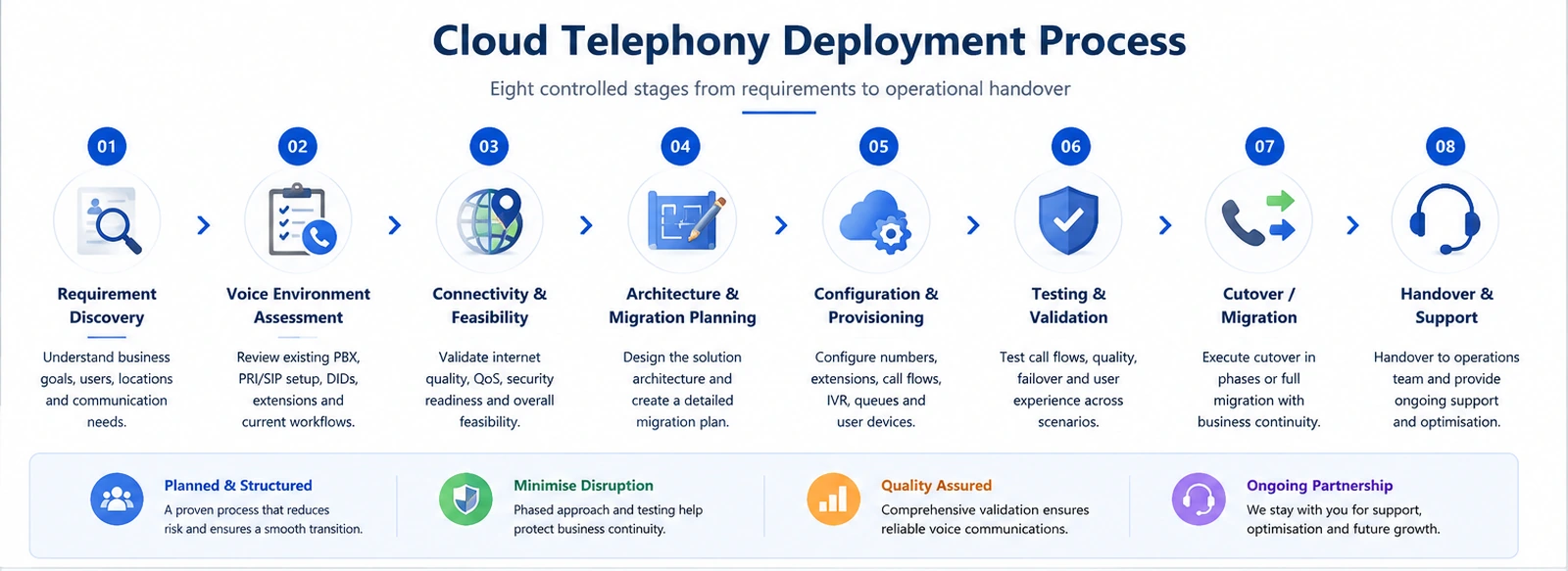
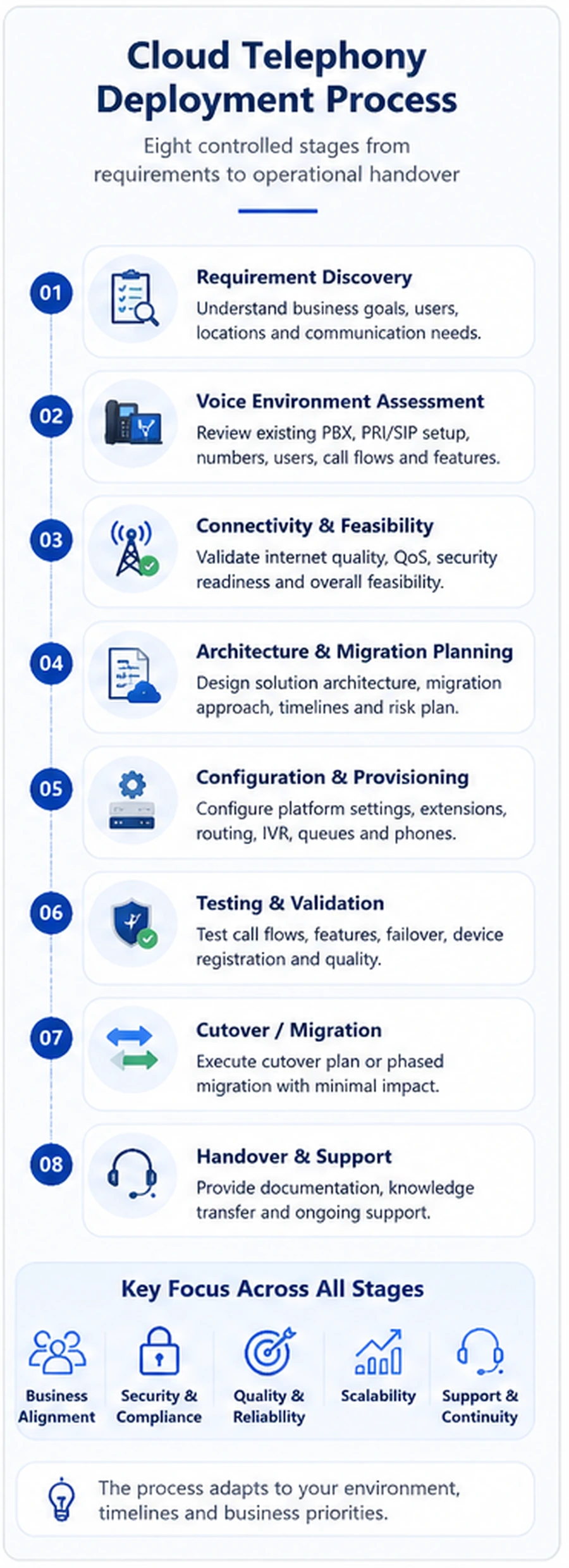
Requirement Discovery
Document users, locations, business numbers, concurrent calls, departments, IVR, queues, recording, reporting, remote-user and contact-centre needs.
Current Voice Environment Assessment
Review PBX, PRI, SIP, DID inventory, analog dependencies, endpoint estate, contracts, operational ownership and existing call flows.
Connectivity and Feasibility Review
Assess LAN, Wi-Fi, firewall, access links, latency, jitter, packet loss, QoS, security policy, endpoint registration and provider availability.
Architecture and Migration Planning
Define target call flows, integration design, coexistence, number movement, migration waves, rollback, continuity and stakeholder responsibilities.
Configuration and Provisioning
Configure users, extensions, DIDs, IVR, queues, permissions, devices, integrations and support routes according to the approved design.
Testing and User Validation
Test inbound and outbound calling, caller ID, IVR, queues, recordings, integrations, failover, device behaviour and representative network conditions.
Cutover or Phased Migration
Move approved users and numbers through controlled windows with communications, validation, rollback criteria and business-owner sign-off.
Handover and Support
Provide administration guidance, escalation paths, documentation, monitoring expectations, change controls and an agreed post-migration review.
Why CloudShots Technologies
CloudShots Technologies supports Cloud Telephony as a provider-neutral assessment, planning and coordination engagement. The objective is to make technical requirements, platform dependencies, commercials, migration responsibilities and operational next steps visible before a commitment is made.
Provider-Neutral Guidance
Evaluate feasible Cloud Telephony platforms and service models against the requirement without assuming one provider in advance.
Enterprise Connectivity Understanding
Assess access links, LAN, Wi-Fi, QoS, firewall and resilience as part of the voice design rather than treating the platform in isolation.
Migration and Integration Planning
Coordinate PBX or PRI coexistence, DID movement, SIP relationships, application integration, pilot scope, cutover and rollback planning.
Single-Point Coordination
Keep business teams, IT, voice, security, provider and implementation stakeholders aligned around assumptions, dependencies and next actions.
Cloud Telephony FAQs
Common questions about Cloud Telephony architecture, business calling, PBX and PRI migration, connectivity, security, integrations and service feasibility.
Plan Your Cloud Telephony Transition
Request a quick callback to discuss your Cloud Telephony, existing PBX, PRI/SIP coexistence or migration requirements. Our team will contact you to understand your current environment and practical next steps.