

Connectivity Built Around Business Requirements
Enterprise Connectivity Solutions
CloudShots Technologies helps businesses plan, evaluate and coordinate reliable connectivity across offices, branches, data centres, cloud environments and distributed operations.
Build a practical network strategy that brings business internet, private connectivity, cloud access and enterprise voice into one coordinated plan aligned to your operational requirements.

Solution portfolio
Enterprise Connectivity Portfolio
Enterprise connectivity requirements vary with the number of locations, application mix, bandwidth demand, resilience objectives, cloud strategy, voice environment, business continuity priorities and geography. The right design may use one service at a single site or combine several services across a distributed organisation.
Internet Leased Line
Dedicated, symmetrical internet access for offices and operational sites that depend on stable cloud, voice, video and business application performance.
Point-to-Point Connectivity
A direct private connection between two locations for controlled inter-office traffic, application access, data movement or data-centre connectivity.
MPLS VPN
Private multi-site WAN connectivity for organisations that require governed routing, traffic separation and consistent branch-to-site communication.
SD-WAN
Policy-based WAN control that helps distributed businesses use multiple network paths, improve application visibility and standardise branch connectivity.
SIP Trunk
IP-based voice connectivity for compatible PBX and IP-PBX environments, planned around concurrent calls, numbering, quality and resilience.
PRI
Structured digital voice connectivity for established PBX environments, including capacity planning, continuity requirements and migration considerations.
Cloud Telephony
Hosted business voice capabilities for organisations seeking flexible user, branch and customer communication without relying on an on-site PBX at every location.
Cloud Connectivity
Connectivity architecture for secure, efficient access to cloud workloads, SaaS platforms, private cloud, backup environments and hybrid infrastructure.
Business requirements
Connectivity Designed Around Business Requirements
Connectivity decisions should begin with the work the network must support, the operational impact of interruption and the controls required across each location.
Reliable Business-Critical Internet Access
Support cloud applications, video, customer systems and daily operations with a service model aligned to site criticality and restoration needs.
Connecting Headquarters and Branches
Give distributed teams dependable access to shared applications and services through an architecture suited to the number, role and geography of sites.
Application and Cloud Performance
Plan paths, capacity, routing and security around SaaS, public cloud, private cloud and data-centre workloads rather than treating all traffic alike.
Network Resilience and Continuity
Identify single points of failure and define appropriate secondary links, route diversity, failover behaviour, monitoring and recovery ownership.
Secure Multi-Location Connectivity
Coordinate segmentation, firewalls, secure access and routing policy so that branches and remote users reach only the resources they need.
Voice, Data and Cloud Convergence
Account for voice quality, concurrent calls, application traffic and cloud access together so one workload does not undermine another.
Requirement-led architecture
Enterprise Connectivity Architecture
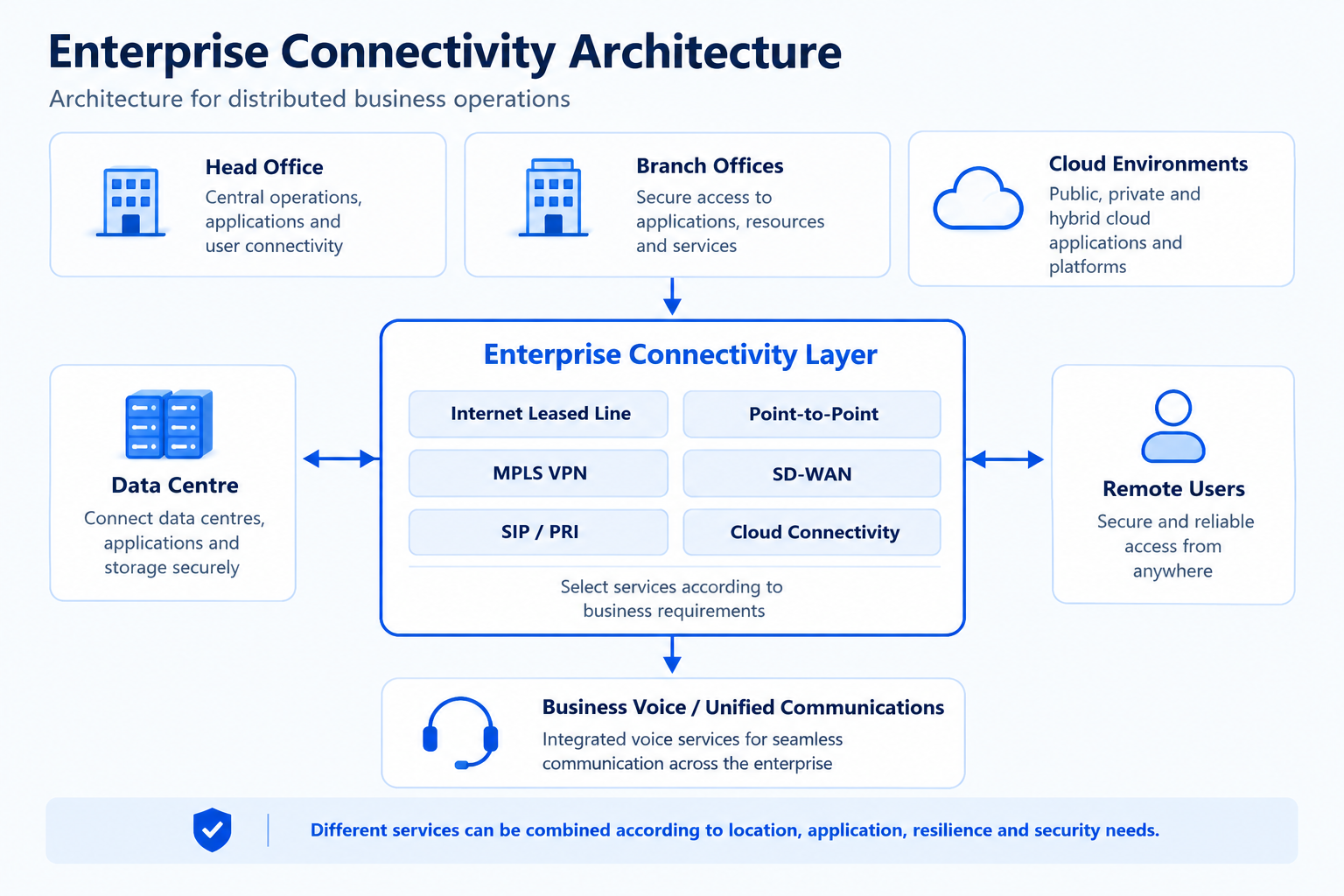
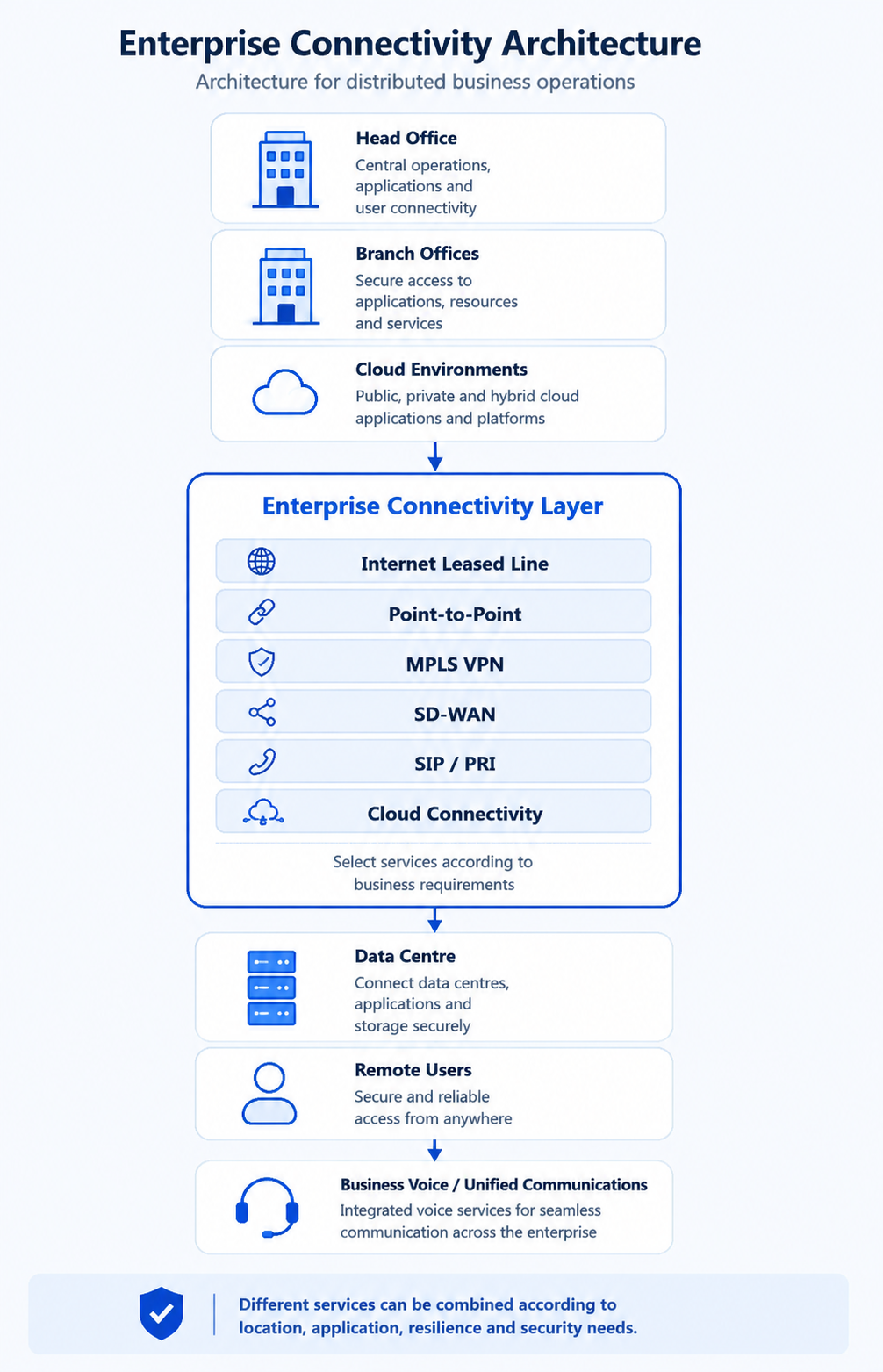
An enterprise connectivity architecture defines how headquarters, branches, cloud environments, data centres, remote users and business communications exchange traffic. It connects business requirements to network paths, routing policy, security controls, monitoring and operational ownership.
The connectivity layer can include Internet Leased Line, Point-to-Point connectivity, MPLS VPN, SD-WAN, SIP or PRI, and Cloud Connectivity. These services are options within the architecture, not a mandatory bundle. Each location should use the services justified by its applications, availability requirements, security obligations and commercial constraints.
- Underlay: physical and provider connectivity suited to capacity, location and recovery requirements.
- Routing and policy: controlled paths between sites, cloud workloads, voice platforms and users.
- Resilience: secondary links and failover behaviour designed around business impact.
- Security and operations: segmentation, secure access, monitoring, escalation and change control.
CloudShots planning method
A Practical Approach to Enterprise Connectivity
A structured process keeps requirements, feasibility, architecture and implementation dependencies visible to business, technical and provider stakeholders.
Understand Requirements
Document locations, users, applications, bandwidth, voice, cloud, resilience and security considerations before comparing services.
Assess Connectivity Options
Evaluate suitable technologies against business impact, technical fit, operating model, implementation dependencies and commercial priorities.
Feasibility & Provider Coordination
Begin feasibility with City / Area / Location Name + Pincode. Complete installation or street addresses are collected later during feasibility or order processing where required.
Architecture & Solution Planning
Define topology, redundancy, cloud access, voice integration, security controls and continuity arrangements as one coordinated design.
Deployment Coordination
Coordinate feasibility, provisioning, implementation, validation and handover while keeping responsibilities, dependencies and next actions visible.
Industry context
Connectivity for Distributed and Digital Businesses
Industry requirements differ, but most connectivity programmes must support some combination of branches, cloud applications, data-centre access, business voice, remote work, disaster recovery and secure inter-office networking.
IT & ITeS
Cloud platforms, development environments, customer operations, remote support and multi-site delivery.
BFSI
Controlled branch access, resilient application paths, monitoring, segmentation and continuity planning.
Healthcare
Reliable access for clinical, administrative, imaging, cloud and distributed facility workflows.
Manufacturing
Plant, warehouse, office, cloud and supplier connectivity aligned to operational technology boundaries.
Retail
Store, warehouse and head-office connectivity for transactions, inventory, communications and central operations.
Education
Campus and multi-site access for learning platforms, administration, collaboration and cloud services.
Professional Services
Secure access to client systems, SaaS platforms, voice services and hybrid work environments.
Multi-Location Enterprises
Standardised branch connectivity, central visibility, resilient cloud access and coordinated service operations.
Plan Your Enterprise Connectivity
Discuss your locations, connectivity requirements, cloud environment, voice infrastructure and resilience objectives with CloudShots Technologies.