

PRIVATE SITE-TO-SITE CONNECTIVITY
Point-to-Point Connectivity for Dedicated Site-to-Site Networks
Connect two defined business locations through a dedicated private service designed for controlled transfer of applications, voice, data and operational traffic.
CloudShots Technologies coordinates requirements, feasibility, technical design and implementation dependencies around both endpoints.


What Is Point-to-Point Connectivity?
Point-to-Point Connectivity is a private site-to-site service between two defined business endpoints. Depending on the service design, it may provide Layer 2 or Layer 3 connectivity and may support symmetrical bandwidth, routing, QoS and monitoring options where applicable.
Organisations use it when traffic must move directly between locations such as a head office and branch, office and data centre, two data centres, a production site and corporate office, two campuses, or a primary and disaster recovery site.
Because the service has two fixed endpoints, the scope should define both ends together. Building readiness, handoff, routing or access constraints at either location can affect the complete delivery. Buyers should therefore review end-to-end responsibilities instead of treating each access segment as an isolated purchase.
It is one component within a wider enterprise connectivity strategy. The decision should account for applications, traffic volume, interface and routing requirements, resilience objectives, security policy, operational support and technical feasibility at both endpoints.
Where It Fits
Point-to-Point Connectivity is designed for controlled traffic exchange between two sites. It is conceptually different from an Internet Leased Line, which connects a site to the internet.
For private connectivity across many sites, an MPLS VPN may be more suitable. SD-WAN adds central policy and path selection across one or more underlay services. Cloud-specific access should be assessed as part of the cloud and data-centre architecture.
- Define the two endpoints and application dependencies.
- Size bandwidth using traffic evidence and growth needs.
- Review route, interface, handoff and security requirements.
- Decide whether secondary paths or diverse access are justified.
Point-to-Point Connectivity Capabilities
Service capabilities depend on location feasibility, selected design and contracted terms. The assessment should establish what each endpoint and application actually require.
Dedicated Site-to-Site Connectivity
Creates a defined private path for business traffic between two locations without treating public internet access as the primary transport.
Symmetrical Bandwidth Options
Supports balanced send and receive capacity where available, useful for replication, collaboration and two-way application traffic.
Application and Data Transfer
Provides a controlled path for private applications, storage movement, central systems and high-volume operational data.
Voice and Real-Time Traffic Support
Can support latency-sensitive voice and collaboration when capacity, QoS, routing and the wider voice environment are correctly planned.
Resilience and Path Diversity Planning
Allows secondary service, diverse access and failover options to be evaluated against operational impact and endpoint feasibility.
Monitoring and Operational Coordination
Defines monitoring, fault escalation, change control and ownership across customer, access, equipment and service responsibilities.
Point-to-Point Connectivity Architecture
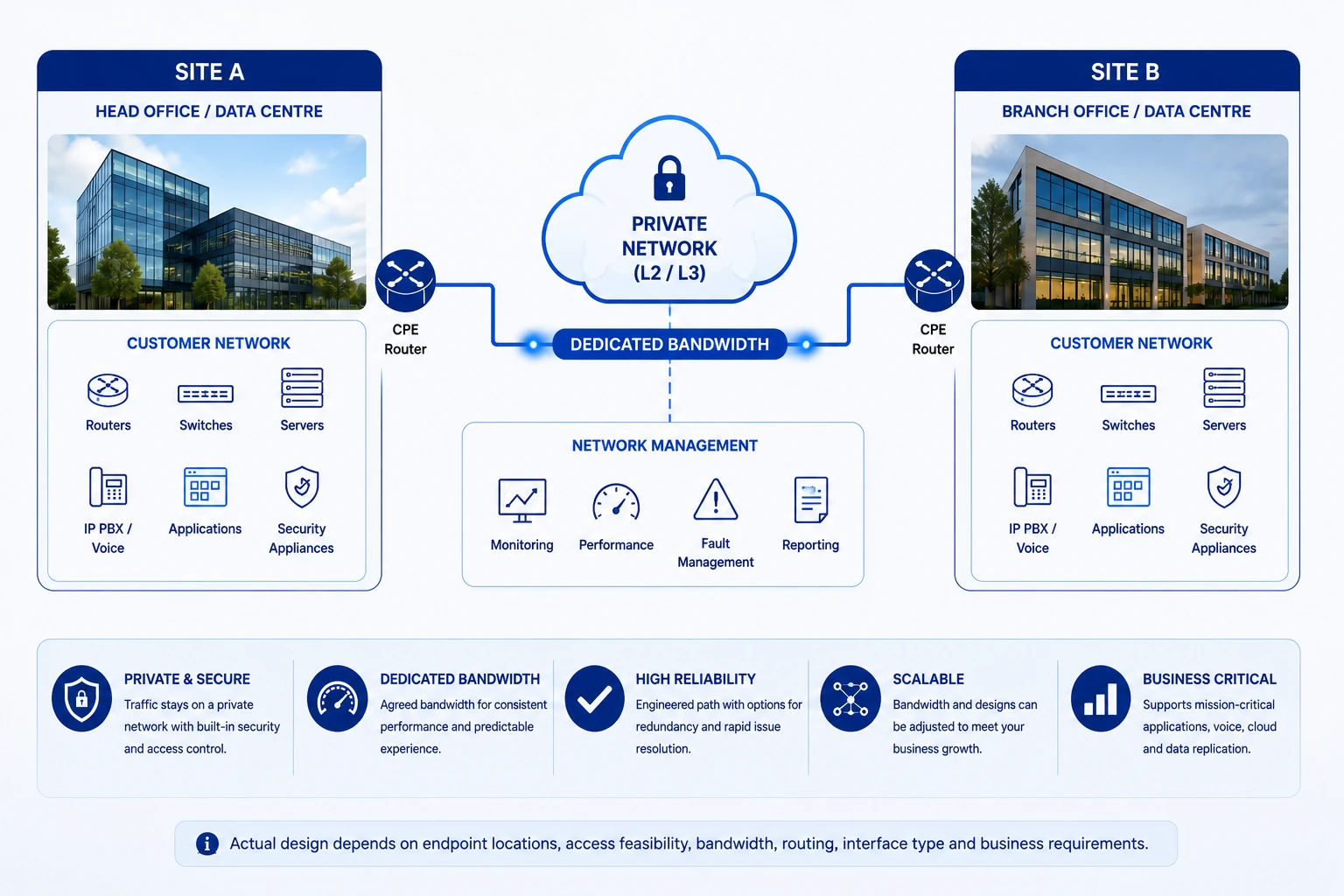
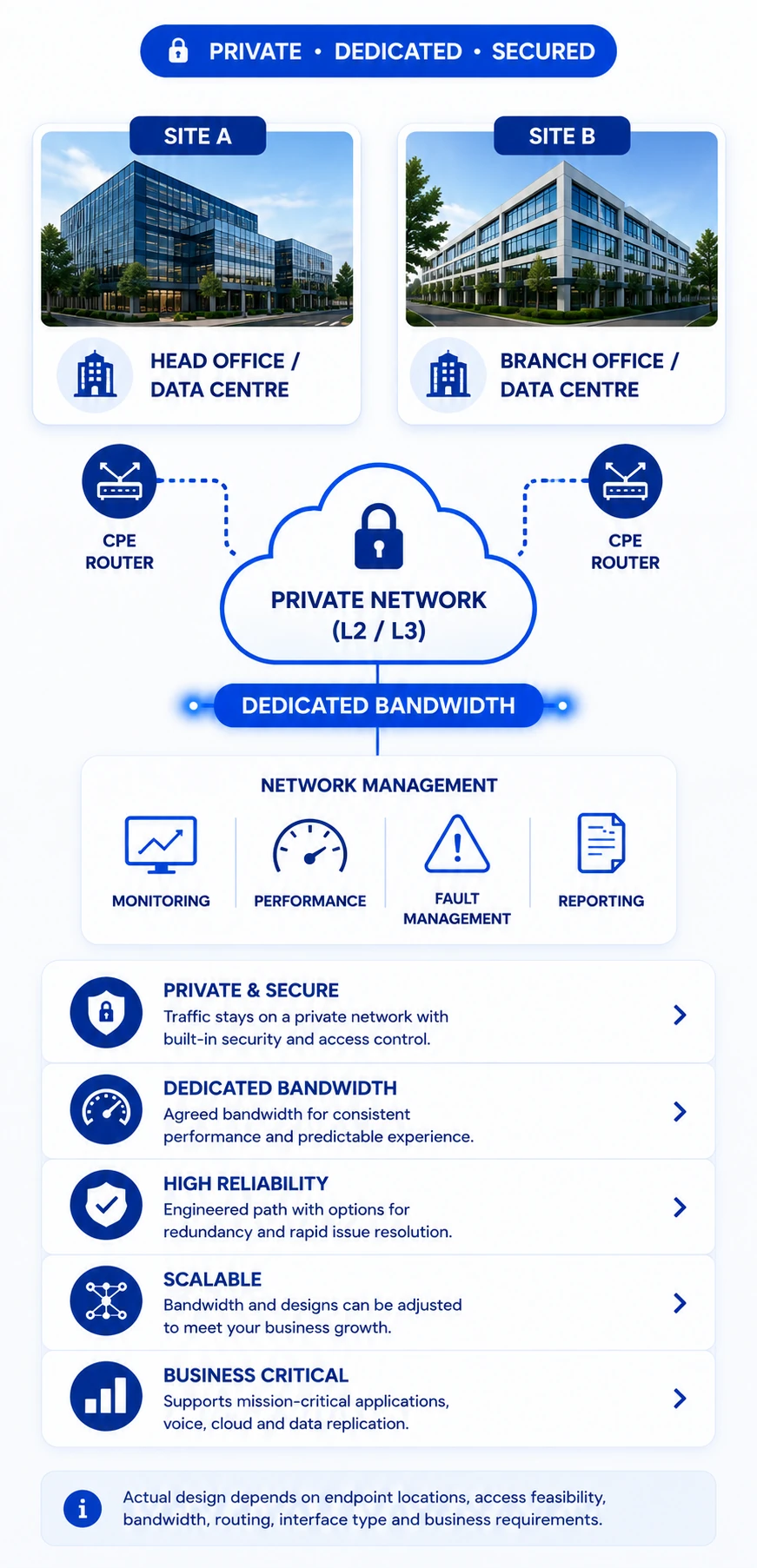
Design from Both Endpoints Inward
The logical path begins at Endpoint A, passes through its access or last-mile connection, crosses the point-to-point service, and reaches Endpoint B through the second access connection. Endpoints may be a head office, branch, data centre, disaster recovery site, production facility or campus.
The handoff may be Layer 2 or Layer 3 depending on the selected service. Design reviews should confirm bandwidth, interface type, addressing, routing ownership, maximum frame considerations where relevant, security boundaries and application dependencies.
Resilience requires separate analysis. A second service does not create meaningful diversity unless access paths, equipment, power, routing and failure behaviour are understood. Monitoring and escalation responsibilities should be agreed before handover.
For critical applications, acceptance criteria should be agreed before testing. Relevant checks may include endpoint reachability, route exchange, expected capacity, error-free transfer, application response, monitoring visibility and recovery behaviour where a secondary path is in scope.
Enterprise Use Cases and Business Applications
The service is most useful when two known locations exchange important private traffic and the design can be evaluated against a clear operational purpose.
Head Office to Branch
Connect a key branch to central applications, shared services, voice systems and corporate resources.
Office to Data Centre
Provide a private path from users and office systems to hosted servers, storage and protected workloads.
Data Centre to Data Centre
Support controlled workload movement, replication and inter-site services after capacity and recovery requirements are assessed.
Primary Site to DR Site
Carry replication and recovery traffic as part of a tested continuity architecture with defined recovery objectives.
Manufacturing or Plant Connectivity
Link production and corporate environments while respecting segmentation, operational dependencies and security policy.
High-Volume Application or Data Transfer
Plan predictable capacity for sustained private transfers without mixing the requirement with unrelated internet traffic.
Deployment and Feasibility Process
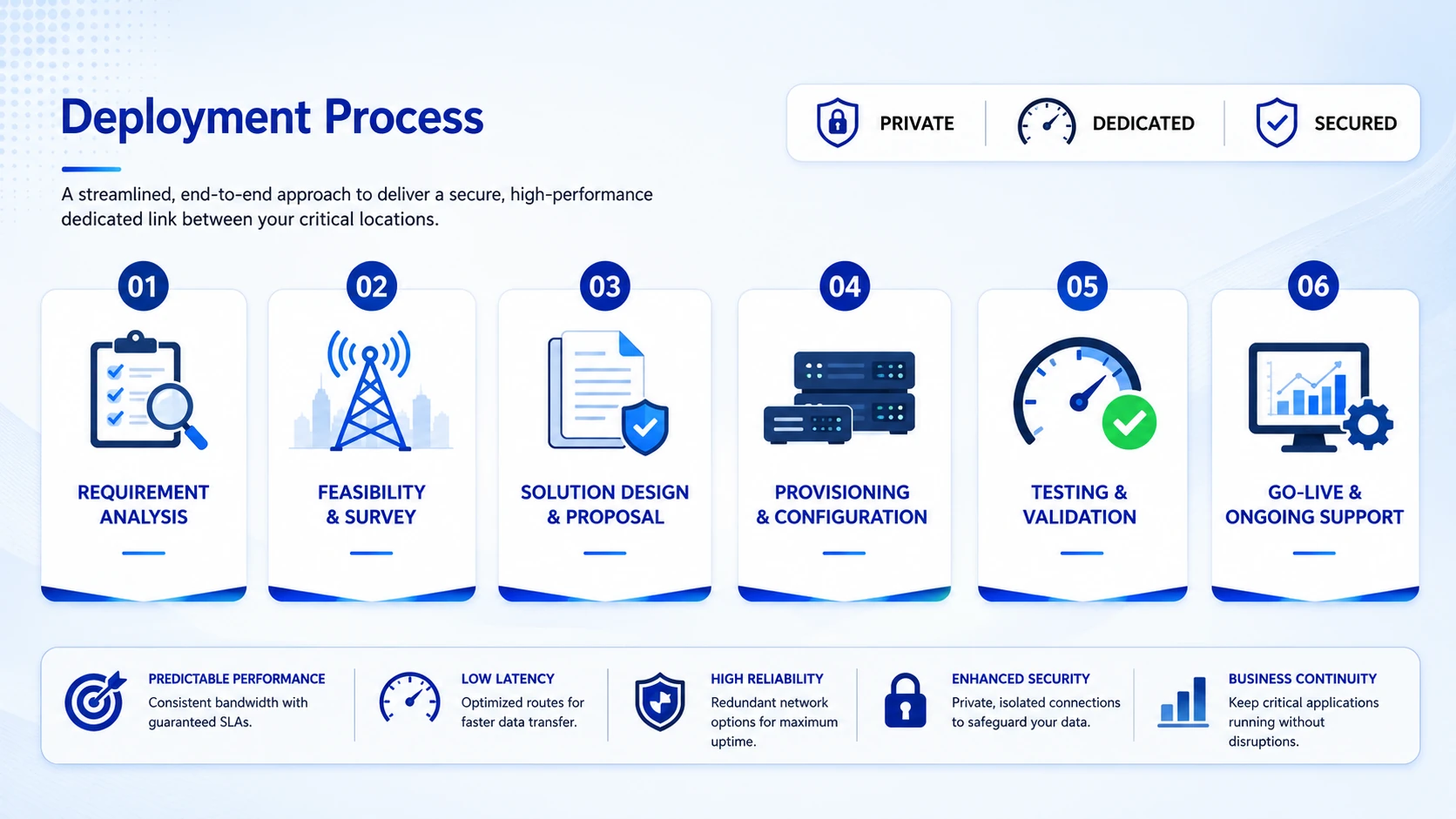
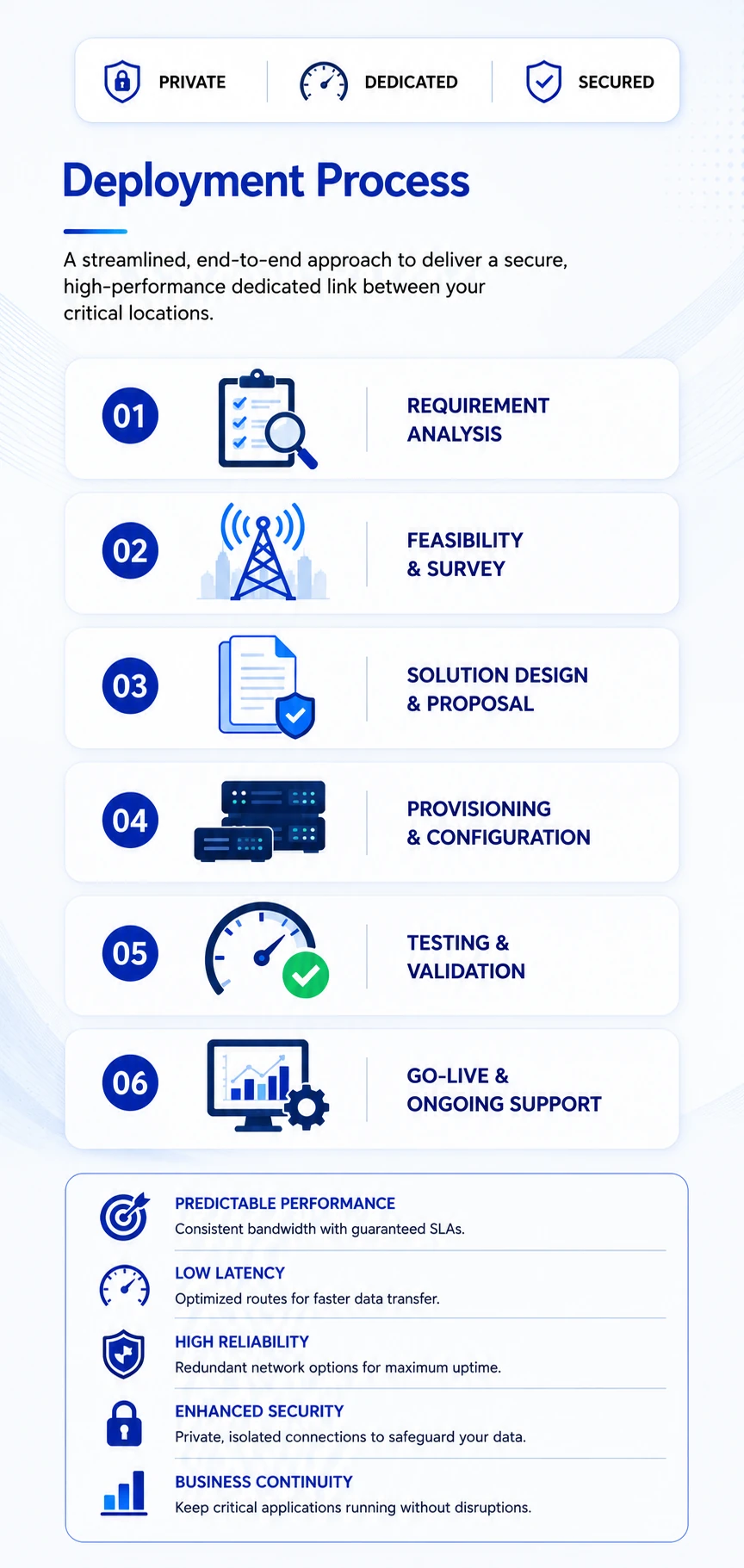
Deployment begins by defining both endpoints and the required business outcome. Initial feasibility should use Endpoint A: City / Area / Location Name + Pincode and Endpoint B: City / Area / Location Name + Pincode. Complete installation or street addresses may be collected later during feasibility, technical validation or order processing where required.
Before order placement, confirm who supplies customer-edge equipment, who owns routing changes, which teams approve building access, how planned work will be communicated and what evidence will be required for technical acceptance.
Requirement Discovery
Document the business purpose, applications, traffic profile, security needs, service expectations and target timing.
Endpoint Location Capture
Record the approved City / Area / Location Name + Pincode information for Endpoint A and Endpoint B.
Feasibility Assessment
Review service availability, access method, building readiness, path options and dependencies at both locations.
Bandwidth, Interface and Routing Design
Confirm capacity, handoff, addressing, routing ownership, QoS requirements and customer equipment readiness.
Commercial and Technical Review
Compare scope, contracted terms, responsibilities, one-time work, recurring charges and implementation assumptions.
Provisioning Coordination
Coordinate surveys, approvals, access, equipment, scheduling and stakeholder actions without obscuring dependencies.
Testing and Validation
Validate handoff, reachability, routing, agreed capacity, application behaviour and failover where included in scope.
Handover and Operational Readiness
Record service details, escalation paths, monitoring responsibilities, acceptance results and change-control ownership.
Why CloudShots Technologies
CloudShots Technologies helps keep business requirements, design choices, feasibility findings and stakeholder responsibilities connected throughout the evaluation and implementation process.
Requirement-Led Planning
Start with endpoints, applications, traffic, resilience and operational impact before selecting a service design.
Technical & Commercial Coordination
Compare feasibility, interfaces, routing, responsibilities, contracted terms and commercials through one structured review.
Multi-Service Architecture Perspective
Assess how the connection complements internet access, private WAN, SD-WAN, cloud access and business voice.
Implementation & Operational Coordination
Keep surveys, dependencies, testing, handover, monitoring and escalation actions visible across stakeholders.
Point-to-Point Connectivity FAQs
Common questions about service design, endpoints, bandwidth, integration, resilience and feasibility.
Plan Your Point-to-Point Connectivity
Request a quick callback to discuss Endpoint A, Endpoint B, bandwidth, applications, resilience, routing or handoff requirements, and your target implementation needs.
CloudShots Technologies will help organise the technical and commercial inputs required for a practical feasibility review.