

MPLS VPN for Secure Multi-Site Business Connectivity
MPLS VPN is a private enterprise WAN service used to connect headquarters, branches, data centres and business locations through controlled routing rather than the open public Internet. It is suited to organisations that need predictable traffic handling for business applications, voice, video, ERP access and centralised network control across many sites.
For teams planning branch expansion, network consolidation or data centre access, MPLS VPN can provide a structured foundation for private multi-site connectivity, QoS policy design and backup path planning. CloudShots Technologies helps evaluate requirements, location feasibility and provider options without positioning any single carrier as the default answer. The aim is to reduce guesswork before procurement begins, so technical and buying teams can compare the same site list, application needs and operational constraints before committing budget.
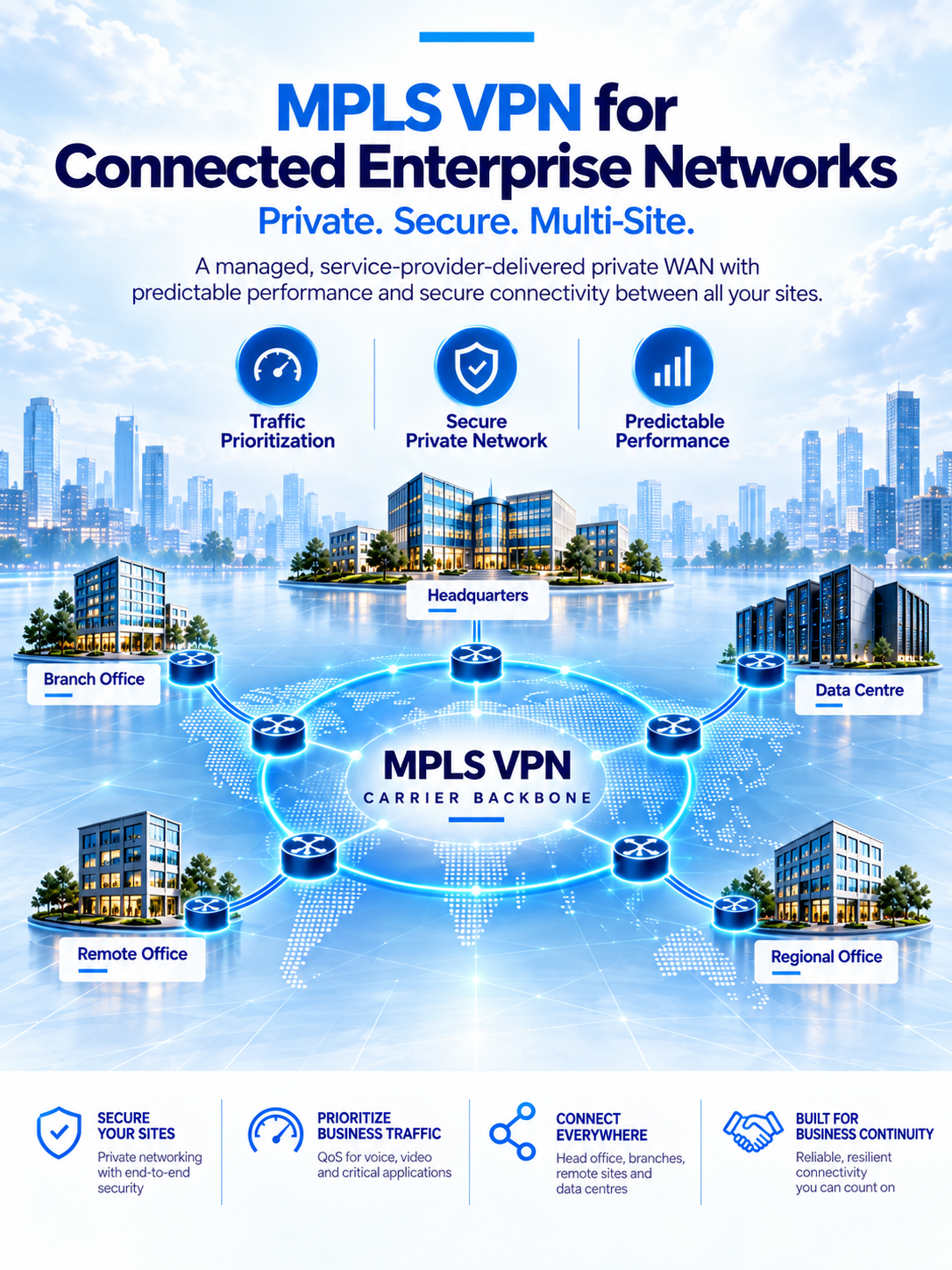
MPLS VPN Overview
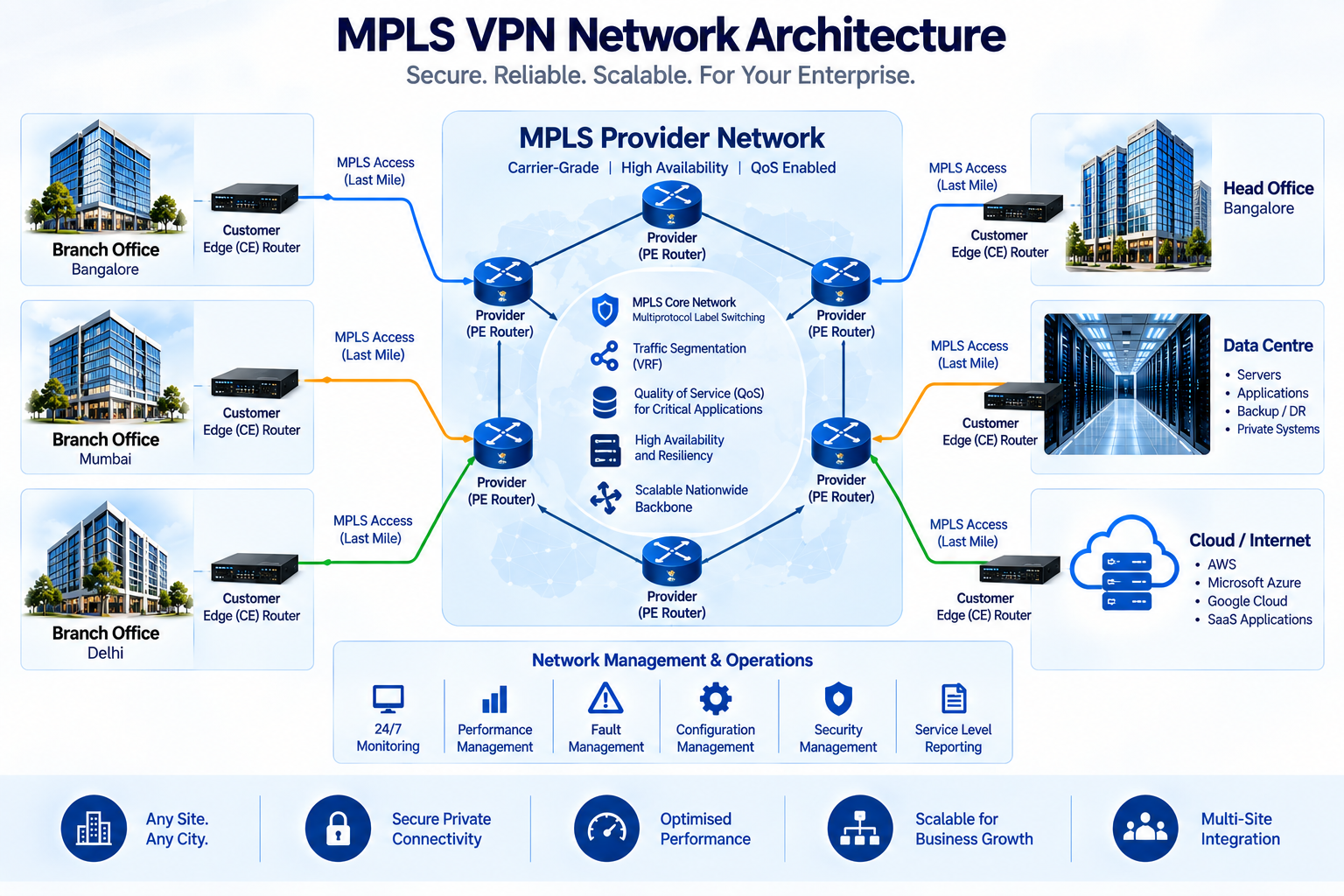
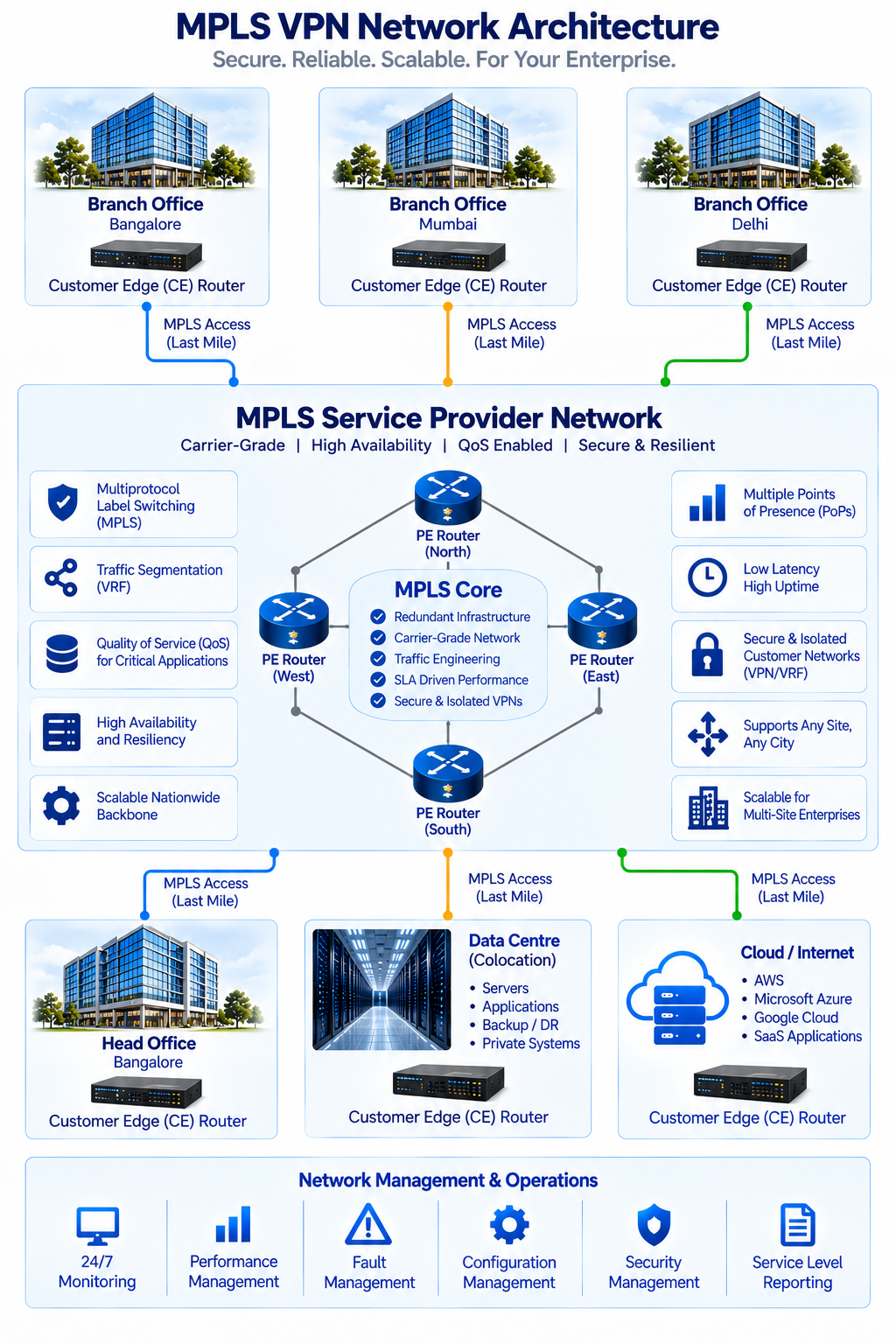
An MPLS VPN is a managed private routed WAN that separates enterprise traffic using provider network controls. Unlike normal public Internet connectivity, its role is not simply to provide access to websites or SaaS platforms. It is used to interconnect business sites, central applications and shared infrastructure through defined routing, provider edge policy and traffic classes.
Enterprises use MPLS VPN where branch-to-branch and branch-to-data-centre communication requires predictable design, central governance and better traffic segmentation than a basic Internet VPN can usually provide on its own. It can also sit beside Internet services, SD-WAN and cloud connectivity in a hybrid architecture, which makes it useful for organisations that still need a controlled WAN foundation for distributed operations. The procurement conversation should therefore include routing ownership, escalation paths and application criticality, not only monthly circuit pricing.
Business Outcomes
Reliable Multi-Site Connectivity: Connect offices, branches and operating locations through a private WAN design with planned routing.
Application Traffic Prioritisation: Use QoS planning to separate voice, video, ERP and critical business applications from lower-priority traffic.
Scalable Branch Expansion: Add new locations through a repeatable feasibility, bandwidth and routing model.
Centralised Enterprise WAN: Keep routing, access, provider coordination and escalation easier to govern across many sites.
Key MPLS VPN Capabilities
Modern MPLS VPN planning should focus on business use, routing behaviour, application priority and operational support rather than circuit labels alone. The following capabilities define how the service is usually assessed in an enterprise WAN discussion.
01
Private Any-to-Any WAN Connectivity
MPLS VPN can support controlled communication between branches, headquarters and shared sites without forcing all traffic through a single public path. This helps distributed teams reach central applications through a private WAN model.
02
Quality of Service / Traffic Prioritisation
QoS design helps classify business traffic so voice, video, transaction systems and key applications receive appropriate handling across the WAN. Classification should match real application behaviour, not generic assumptions.
03
Multi-Site Routing
Routing can be planned around site roles, application locations, branch size and centralised access requirements. Good route design reduces avoidable traffic paths and supports clearer operations.
04
Scalable Bandwidth Options
Bandwidth should be sized per site based on users, applications, concurrency, voice, video, backups and future growth. There is no fixed rule that fits every branch.
05
Centralised Network Architecture
A private WAN can simplify governance where several offices depend on shared business platforms, data centre systems or centrally managed security and monitoring teams.
06
Resiliency / Backup Design Options
Backup connectivity can be added using alternate last mile, Internet underlay, SD-WAN or secondary provider options where feasible. Resilience depends on diversity, routing and operational testing.
MPLS VPN Architecture
Design Considerations
Site model: site count, city and area spread, branch roles, bandwidth per site and the applications hosted centrally or locally.
Traffic model: QoS classes, voice and video sensitivity, ERP or transaction traffic, data centre reach and cloud access requirements. This helps determine which applications require priority treatment and which can tolerate ordinary routing behaviour.
Resilience model: last-mile diversity, Internet breakout, backup path selection, failover behaviour and operational escalation. Where Internet backup is required, the underlay can be evaluated alongside Internet Leased Line options and SD-WAN design. The plan should also define how support teams will confirm that failover is working during incidents.
Feasibility model: initial screening should use city, area and PIN Code. Detailed installation information can be collected later when provider options are shortlisted.
Use Cases
MPLS VPN is commonly evaluated for branch-to-HQ connectivity, ERP access, private access to shared applications, voice and video prioritisation, data centre connectivity, multi-location private WANs and hybrid enterprise network architecture.
It can be useful when the business wants a routed WAN model that supports many sites and defined traffic treatment, while still leaving room for Internet breakout, cloud access and backup paths where the design requires them. It is not a replacement for security policy; firewalls, access control and monitoring still need to be planned. The strongest use cases are usually those where business applications, voice or operational workflows are shared across several locations.
Industries
MPLS VPN discussions are common in BFSI, IT and ITeS, healthcare, manufacturing, retail and multi-location enterprises. The technical reason differs by industry: transaction systems, hosted applications, central data platforms, production systems, contact centres, compliance workflows or branch operations.
The right design depends on how each site works, not just the industry label. Application dependency, operating hours, support expectations and location feasibility should lead the decision.
Deployment and Feasibility Process
A useful MPLS VPN deployment process keeps commercial comparison tied to feasibility, routing design and support ownership. CloudShots uses a staged review so the business can move from early screening to implementation without treating every location as identical.
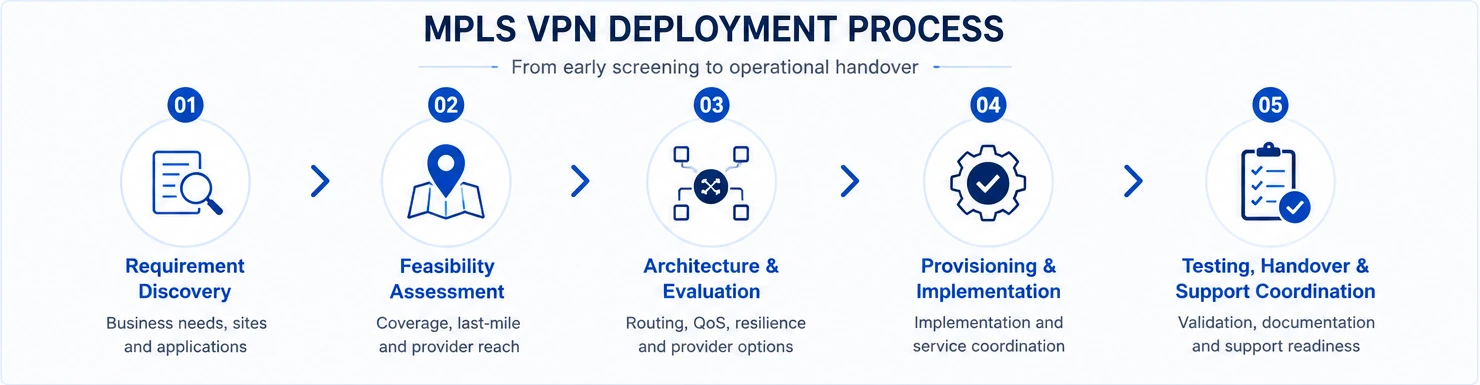
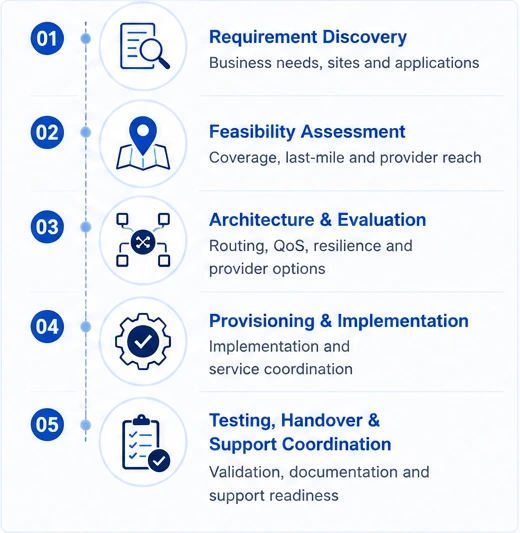
Requirement Discovery
Capture site count, City, Area or Location Name, Postal PIN Code, users, applications, security dependencies, voice or video needs and preferred timelines. At lead stage, location-level information is enough to begin screening.
Site & Feasibility Assessment
Check last-mile availability and provider reach. Feasibility varies by location and may differ even within the same city, so assumptions should be confirmed before budgets are treated as final.
WAN Architecture & Provider Evaluation
Compare design options based on bandwidth, routing, QoS, resilience, cloud or data centre needs, implementation dependencies and commercial fit.
Provisioning & Implementation
Coordinate provider tasks, site readiness, router handoff, routing requirements, access windows and implementation dependencies. Detailed installation address information is collected later during shortlisted provider coordination.
Testing, Handover & Support Coordination
Validate reachability, traffic classes, failover assumptions and escalation paths before treating the service as operational. Handover should include circuit details, router ownership, support contacts and routing or QoS notes.
Why CloudShots for MPLS VPN Planning
CloudShots Technologies positions MPLS VPN as an enterprise connectivity decision, not a one-size-fits-all circuit sale. The role is to help organisations compare feasibility, design and commercial options without claiming ownership of carrier infrastructure. This keeps the review useful for CIO, network, operations and procurement teams who need one shared view of risk, coverage and implementation dependency. It also makes the first commercial review more realistic.
01
Provider-Neutral Evaluation
CloudShots evaluates requirements before suggesting provider options, helping the discussion stay aligned to coverage, feasibility and architecture rather than a pre-decided carrier route.
02
Requirement-Led Planning
The engagement begins with sites, applications, bandwidth, QoS and business priorities. This makes it easier to compare MPLS VPN with SD-WAN, Internet backup or cloud connectivity where relevant.
03
Technical-Commercial Comparison
Options can be compared across feasibility, design fit, commercials, escalation model and implementation dependency so IT and procurement teams can review the same decision frame.
04
Single Point of Engagement
CloudShots can coordinate discussions across business teams, technical teams and provider channels while keeping assumptions, constraints and next actions visible.
MPLS VPN FAQ
These answers address the practical questions enterprise teams usually ask before shortlisting MPLS VPN for private WAN, branch connectivity, QoS and hybrid network planning. They are written for technical review, procurement discussion and early feasibility conversations.