

PRI Lines2026-09-26T10:09:02+05:30

ENTERPRISE VOICE CONNECTIVITY

PRI Lines for Enterprise Voice

Structured multi-channel voice connectivity for business telephony, PBX environments and enterprise calling requirements.

CloudShots Technologies helps evaluate call capacity, PBX compatibility, location feasibility and implementation needs with the relevant service providers.

  • Structured enterprise voice
  • Multiple concurrent calls
  • PBX integration
  • Business continuity planning
Enterprise PRI voice connectivity for business telephony

What Are PRI Lines?

PRI (Primary Rate Interface) is a digital enterprise voice service commonly used to connect business PBX systems to the public telephone network.

In E1-based PRI deployments, a PRI commonly supports up to 30 simultaneous voice channels, subject to operator/network design and service availability. Confirm the contracted capacity and PBX requirements for the specific location.

For distributed organisations, private WAN connectivity may link enterprise sites alongside the voice design. It does not replace the PRI handoff or automatically provide PSTN calling.

Where PRI Fits

Existing PBX Environments

High Call-Volume Offices

Contact Centres

Branch / Corporate Offices

Migration from Legacy Voice

Business-Critical Calling

Core PRI Capabilities

Assess the required calling functions with the selected operator and PBX platform. Direct dialling, caller identification, routing options and expansion are available only where supported and within the agreed service scope.

Multiple Concurrent Voice Channels

PBX Integration

Inbound & Outbound Calling

Direct Dialling Support

Caller Identification Support

Capacity Planning & Expansion

PRI Architecture

An illustrative calling path; the actual interface, gateway and routing arrangement depend on the PBX, operator handoff and agreed design.
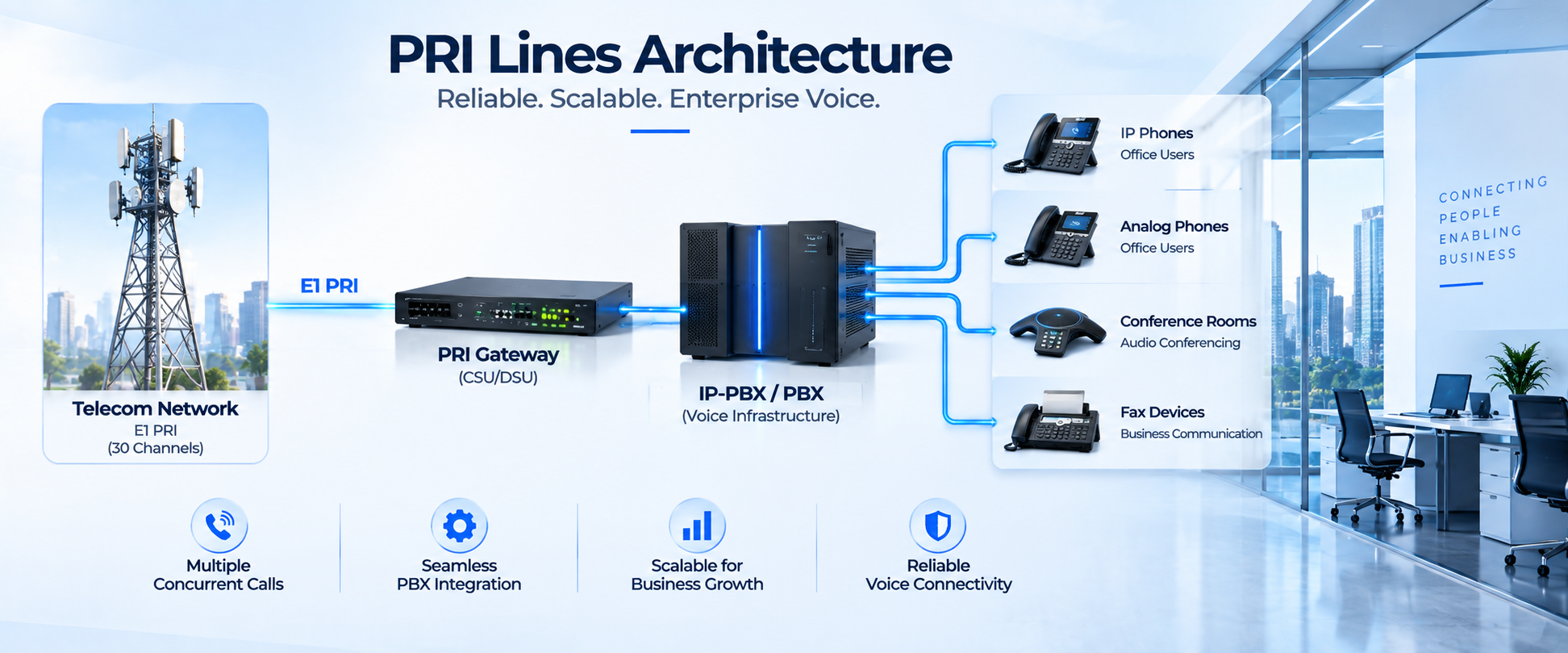
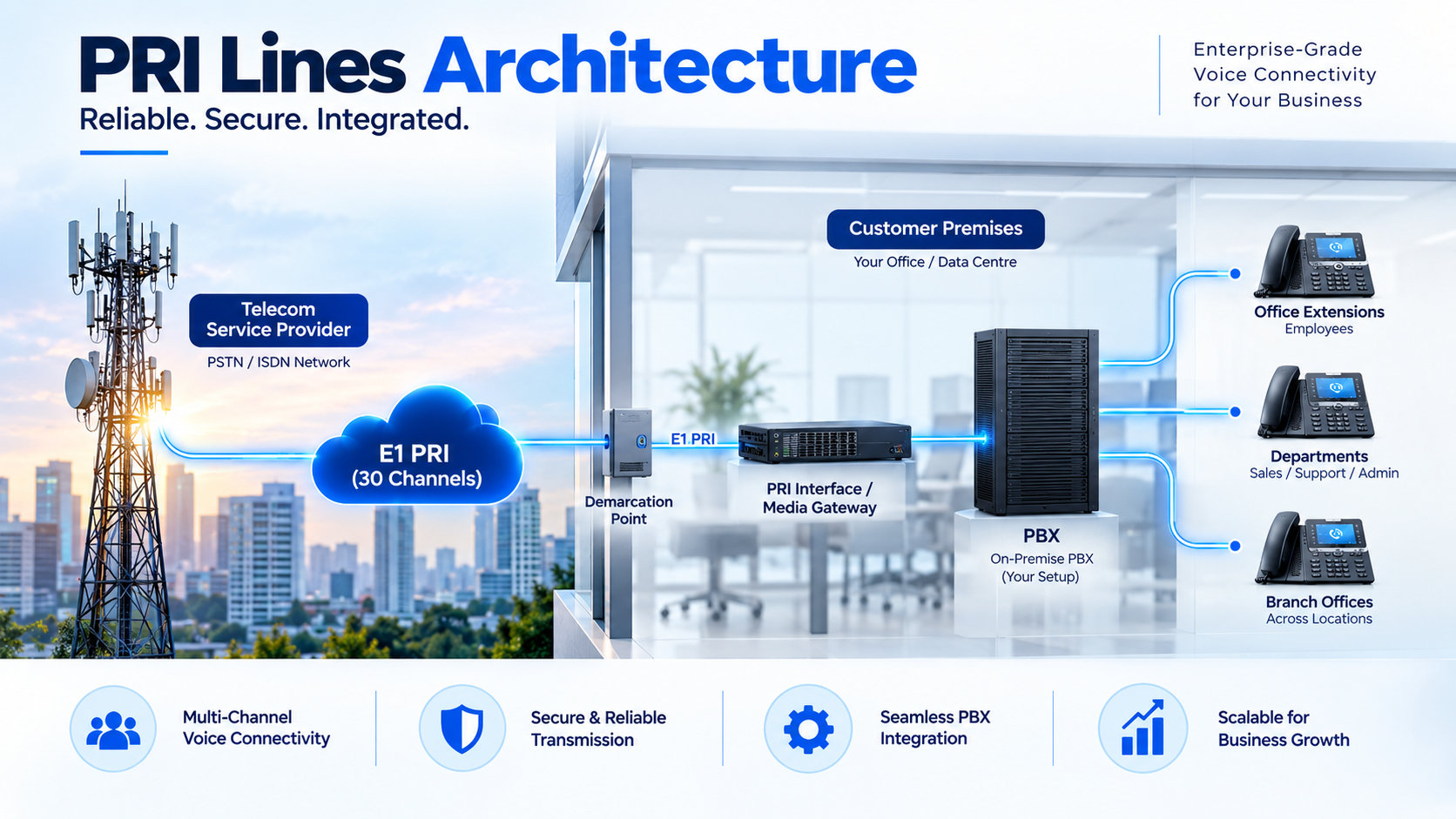
PRI Lines architecture connecting telecom network, PBX and business phones

From Enterprise Phones to the Public Network

Enterprise Users / IP or Digital Phones → Enterprise PBX / IP-PBX → PRI Interface / Gateway, as applicable → PRI Circuit → Telecom / PSTN Network → External Fixed / Mobile Numbers

The customer PBX manages extensions and call routing; a compatible PRI interface or gateway connects it to the service handoff. Validate voice channels, numbering, inbound/outbound routing and the complete calling path.

For an IP-PBX environment, an Internet Leased Line may support separate data or IP services. It is not a prerequisite for carrying calls over the PRI circuit itself.

Where the PBX or gateway is hosted in a data centre, align power, access and network dependencies with the relevant Data Centre Services scope.

Review PBX, gateway, circuit and power failure risks together. Number routing and alternate paths must be agreed and tested; redundancy is not inherent in every deployment.

Capacity & Design Considerations

Size voice capacity around measured business calling patterns, including peak simultaneous calls, call duration and growth, rather than simply employee headcount.

Expected Concurrent Calls

Use busy-hour call records, peak demand and growth assumptions to estimate simultaneous calls. Employee headcount alone does not establish channel requirements.

Existing PBX Compatibility

Validate PRI ports or gateway requirements, signalling compatibility, licences, available interfaces and the PBX support position before ordering.

Numbering / DID Requirements

Review main numbers, direct dialling requirements, number ranges and routing. Availability and any retention or migration depend on the operator and applicable service scope.

Inbound vs Outbound Call Mix

Assess incoming demand, outbound calling patterns, queueing and call-handling policies. Agree any channel allocation or restrictions supported by the service.

Redundancy Requirements

Evaluate circuit, route, PBX, gateway and power dependencies. A second circuit does not prove path diversity or automatic recovery of all calling functions.

Location & Feasibility

Confirm service availability, handoff requirements, building readiness and equipment access at the proposed location before committing to scope or timing.

Enterprise PRI Use Cases

PRI can fit enterprise calling environments where a suitable digital interface and service remain available. Match each use case to the existing PBX and continuity requirements.

Corporate Office Telephony

Contact Centre Voice

Centralised PBX Calling

Branch Office Voice

Existing PBX Modernisation

Voice Continuity / Alternate Routing Planning

For multi-site or branch designs, SD-WAN can support policy and path selection for associated IP traffic. PRI circuit availability, voice routing and failover still require their own assessment.

PRI vs SIP Trunk

Compare the interface and operating requirements against your existing environment; neither option is universally better.

PRI Lines

  • Traditional digital enterprise voice interface
  • Commonly integrates with PRI-capable PBX systems
  • Channel-based capacity model
  • Suitable where existing infrastructure depends on PRI

SIP Trunk

The appropriate option depends on the existing PBX environment, migration strategy, location feasibility, continuity requirements and voice architecture.

If modernisation includes hosted IP-PBX or cloud voice components, assess relevant cloud network connectivity separately. Availability, routing and security depend on the chosen platform; a cloud connection alone does not provide PSTN voice service.

Deployment & Feasibility

Plan PRI deployment around your existing voice environment, location feasibility, capacity requirements and migration needs before provisioning begins.

Requirements Discovery

Location & Feasibility Review

PBX & Interface Validation

Numbering & Capacity Design

Provisioning & Configuration

Testing & Acceptance

Go Live & Ongoing Support

Requirements Discovery

Review the existing PBX environment, expected call volumes, business locations, numbering requirements and operational needs.

Location & Feasibility Review

Assess service availability for the required location and identify network, handoff and site-readiness considerations.

PBX & Interface Validation

Confirm PBX compatibility, PRI interface requirements, gateway requirements where applicable, and the proposed handoff between the enterprise voice environment and the service.

Numbering & Capacity Design

Plan the required voice-channel capacity, DID or numbering requirements, inbound and outbound calling needs, and future expansion considerations.

Provisioning & Configuration

Coordinate circuit provisioning, PRI handoff, PBX or gateway configuration, numbering setup and call-routing requirements.

Testing & Acceptance

Validate inbound and outbound calling, channel operation, numbering, call routing and agreed failover or continuity arrangements before production use.

Go Live & Ongoing Support

Move the PRI service into production and support ongoing operations, capacity changes, troubleshooting and future voice-infrastructure requirements.

Requirements Discovery

Review the existing PBX environment, expected call volumes, business locations, numbering requirements and operational needs.

Location & Feasibility Review

Assess service availability for the required location and identify network, handoff and site-readiness considerations.
Website enquiry location requirement: City / Area / Location Name + PIN Code only.

PBX & Interface Validation

Confirm PBX compatibility, PRI interface requirements, gateway requirements where applicable, and the proposed handoff between the enterprise voice environment and the service.

Numbering & Capacity Design

Plan the required voice-channel capacity, DID or numbering requirements, inbound and outbound calling needs, and future expansion considerations.

Provisioning & Configuration

Coordinate circuit provisioning, PRI handoff, PBX or gateway configuration, numbering setup and call-routing requirements.

Testing & Acceptance

Validate inbound and outbound calling, channel operation, numbering, call routing and agreed failover or continuity arrangements before production use.

Go Live & Ongoing Support

Move the PRI service into production and support ongoing operations, capacity changes, troubleshooting and future voice-infrastructure requirements.

Requirements Discovery

Review the existing PBX environment, expected call volumes, business locations, numbering requirements and operational needs.

Location & Feasibility Review

Assess service availability for the required location and identify network, handoff and site-readiness considerations.
Website enquiry location requirement: City / Area / Location Name + PIN Code only.

PBX & Interface Validation

Confirm PBX compatibility, PRI interface requirements, gateway requirements where applicable, and the proposed handoff between the enterprise voice environment and the service.

Numbering & Capacity Design

Plan the required voice-channel capacity, DID or numbering requirements, inbound and outbound calling needs, and future expansion considerations.

Provisioning & Configuration

Coordinate circuit provisioning, PRI handoff, PBX or gateway configuration, numbering setup and call-routing requirements.

Testing & Acceptance

Validate inbound and outbound calling, channel operation, numbering, call routing and agreed failover or continuity arrangements before production use.

Go Live & Ongoing Support

Move the PRI service into production and support ongoing operations, capacity changes, troubleshooting and future voice-infrastructure requirements.

Location Guidance

For initial feasibility, provide City / Area / Location Name + Pincode. A complete installation address can be collected later during feasibility or order processing.

Disclaimer

Service availability, channel capacity, numbering options and provisioning timelines are subject to location feasibility, operator capability, existing PBX environment and customer requirements.

Trusted Across Industries

Technology

Healthcare

Banking & Financial Services

Manufacturing

Retail & FMCG

Government & PSU

Why CloudShots Technologies

Bring enterprise calling requirements, PBX interfaces and practical delivery dependencies together. CloudShots assists with planning, technical and commercial inputs, implementation coordination and the agreed ongoing support scope.

Enterprise Voice Planning

PBX & Interface Coordination

Multi-Location Requirement Support

Technical & Commercial Assistance

Migration & Implementation Support

Ongoing Voice Infrastructure Support

PRI FAQs

Common questions about channel capacity, PBX compatibility, numbering and feasibility.

What is a PRI line?2026-09-22T12:48:21+05:30

PRI, or Primary Rate Interface, is a digital enterprise voice service commonly used to connect a business PBX to the public telephone network. Suitability depends on the PBX interface, local service availability and calling requirements.

How many simultaneous calls can a PRI support?2026-09-22T12:48:47+05:30

In E1-based deployments, a PRI commonly supports up to 30 simultaneous voice channels, subject to operator/network design and service availability. Confirm the contracted channel capacity, PBX interface and any restrictions for the proposed service.

What is the difference between PRI and SIP Trunk?2026-09-22T12:49:42+05:30

PRI uses a digital voice interface commonly associated with PRI-capable PBX equipment. SIP Trunk provides IP-based voice connectivity, commonly used with an IP-PBX and, where required, an SBC. The appropriate choice depends on existing equipment, feasibility, migration plans and continuity needs; neither is universally better.

Can PRI work with an existing PBX?2026-09-22T12:50:07+05:30

It may, if the PBX has a compatible PRI interface, signalling support and the required licences. Some IP-PBX environments need a suitable gateway. Equipment and operator handoff compatibility must be validated before ordering.

What information is needed for PRI feasibility?2026-09-22T12:50:43+05:30

Share City / Area / Location Name + Pincode, the existing PBX make/model and interface where known, expected simultaneous calls, numbering needs and any migration or continuity requirements. Detailed installation information can follow during feasibility or order processing.

Is a full installation address required during website enquiry?2026-09-22T12:51:18+05:30

No. For initial location details, City / Area / Location Name + Pincode is sufficient. A full address and site-access information can be collected later when required for detailed feasibility or installation planning.

Can existing business numbers be retained or migrated?2026-09-22T12:51:50+05:30

Retention or migration depends on the current service, number allocation, location, applicable requirements and the operator’s supported process. Check the specific numbers and migration approach before committing; portability is not guaranteed.

How is PRI capacity planned?2026-09-22T12:52:13+05:30

Review busy-hour simultaneous calls, incoming and outgoing call patterns, call duration, queues, current utilisation and expected growth. Employee headcount alone is insufficient. Match the agreed capacity to PBX capabilities and available service options.

Can PRI be used for contact centre environments?2026-09-22T12:52:44+05:30

PRI can support suitable contact centre PBX environments where service and interface compatibility are confirmed. Capacity, direct dialling, caller identification, queueing and routing must be assessed against the selected platform and supported service features.

What happens if call capacity increases later?2026-09-22T12:53:11+05:30

Review utilisation and growth with the operator and PBX team. Expansion may require additional channels or circuits, interfaces, licences or an alternative voice design, subject to availability and compatibility. Do not assume every installation can expand without equipment or service changes.

How long does PRI provisioning take?2026-09-22T12:53:54+05:30

Timing depends on location feasibility, operator availability, site and equipment readiness, numbering requirements and approvals. A project-specific estimate can be provided after the relevant checks; there is no universal fixed provisioning timeline.

What redundancy options should be considered?2026-09-22T12:54:21+05:30

Assess circuit and route diversity, PBX and gateway resilience, power backup, numbering/routing behaviour and any alternative calling service. Confirm supported failover, failure dependencies and testing responsibilities. An additional circuit alone does not guarantee continuity or physical path diversity.

Discuss Your PRI Requirement

Discuss your location, current PBX environment, expected call capacity, numbering requirements and migration needs. CloudShots Technologies can help organise the technical and commercial inputs required for feasibility.

For initial location details, City / Area / Location Name + Pincode is sufficient.

Go to Top